
You are here
News Feeds
Orcas may be to blame for some mass dolphin strandings
The Sun Has a Heartbeat
For forty years, a network of telescopes has been listening to the Sun hum and scientists have finally decoded what those sounds reveal about our star's hidden interior. A new study from the University of Birmingham and Yale University has found that the Sun's internal structure quietly shifts between solar cycles, leaving measurable fingerprints deep beneath its surface. It's a discovery that could transform how we forecast space weather and its impact here on Earth.
Sunday Morning's European Fireball Was Probably Only a Few Meters in Diameter
Multiple mobile phones, dashcams, and dedicated meteor cameras capture a fireball over part of Europe on Sunday night. Thousands of people witnessed it, and the ESA's Planetary Defence Team is analyzing it. So far, it looks like it was a few meters in diameter. It lit up the sky, and some debris even struck some buildings in Koblenz, Germany.
The Other Lab Leak Hypothesis: Is Lyme Disease Caused by an Escaped Bioweapon?
Practically everyone has heard of the tick-borne infection known as Lyme disease, even if they don’t live in a high-risk area. Some are aware of long-standing controversies about the consequences of infection or how best to treat it. Our concern here is for a newly emerging controversy about Lyme disease—namely, the theory that it originated as part of a bioweapons program. As U.S. Representative Chris Smith of New Jersey is heard to say while participating in a Department of Health and Human Services roundtable on Lyme disease: “They were weaponizing Ixodes burgdorferi [sic], as we all know.”1
Part of this theory is that Lyme disease’s origins can be traced to the United States Department of Agriculture’s (USDA) Plum Island Animal Disease Laboratory, where it allegedly was developed as a biological weapon, either as a genetically modified organism or by “weaponizing” native ticks to carry a secret pathogen. Plum Island, in fact, would seem to be a good place to center these hypothetical activities, because it has exclusively been the site of a restricted-access USDA facility since 1954. The facility has long conducted research on foreign animal diseases that would devastate the livestock industry in the United States if they were ever introduced accidentally or purposefully as a biological weapon. This research is essential for developing vaccines and measures to prevent potential outbreaks of animal diseases, such as foot-and-mouth disease, African swine fever, and other diseases of domesticated animals.
Plum Island is located off the eastern end of Long Island and about seven miles across the water from the town of Lyme, Connecticut, where what seemed (at the time) to be a new tick-borne disease was identified in the 1970s. Over the past five decades, Lyme disease—as that illness is now called—has been documented in several other states in the northeastern, mid-Atlantic, and north-central U.S., as well as parts of states in the Far West. It is a tick-borne infectious disease affecting tens of thousands of people each year and at an enormous cost to the public’s health and people’s well-being.
Nature poses a greater threat than human design or error as a source of new infectious diseases and epidemics for humans and other animals.The issue of whether the emergence of Lyme disease is the consequence of natural processes or might have originated from humans—namely, as a designed bioweapon, subsequently inadvertently or intentionally released—has become a hot topic in the news, social media, and podcasts. It has prompted calls for an investigation from members of Congress, where an amendment from Representative Smith is now part of the recently passed and White House-signed defense authorization bill. It would seem more convenient to have somebody or some government institution to blame for an emerging infectious disease, rather than natural events. But in reality, nature poses a greater threat than human design or error as a source of new infectious diseases and epidemics for humans and other animals.
Plum Island is a high-containment facility only reachable by boat from Long Island and Connecticut for the daily transport of authorized personnel. Visitors are not allowed, and any intruders are promptly escorted off the island. Deer and other wildlife that may be susceptible to infections and occasionally swim to the island are immediately culled by sharpshooters from helicopters. Such high security has long led to rumors and suspicion among neighboring communities that something nefarious must be going on at Plum Island. The island had undeservedly gained notoriety in the Silence of the Lambs book (1988) and film (1991) in Hannibal Lecter’s telling as “Anthrax Island.”
One of us (DF) worked on Plum Island during the 1990s, conducting research on African swine fever under a USDA research contract with Yale University. African swine fever is a tick-borne disease native to Africa, and it is highly infectious among pigs even without ticks. Access to infected animals required two changes of clothing and a shower before passing through each of two air-tight chambers. But there was no protection for personnel, as these animal diseases do not have the capacity to infect humans. If they did, self-contained spacesuits would be required, as are used for Ebola and other dangerous human pathogens in BSL-4 labs. The Plum Island facility had no capacity to work with human pathogens, and there is no evidence that scientists there ever worked on Lyme disease.
The second of us (AGB) participated in the early 1980s in the discovery and then isolation of the bacterium that causes Lyme disease. The team accomplished this from ticks that were collected at the far end of Long Island, so not far from Plum Island. This sounds suspicious for an escape from the Plum Island lab. But Long Island and Lyme, Connecticut, were not the only places where Lyme disease was occurring at the time. The availability of cultured bacteria led to diagnostic assays that were quickly developed and implemented. Application of these blood tests for laboratory diagnosis in many other places in the United States revealed that the infection was not limited to a small area near Plum Island and had not been so restricted for many years.
Besides New York and Connecticut in the early 1980s, cases were soon identified in other northeastern states, north-central states like Minnesota and Wisconsin, and even across the country in northern California. This is a disease only transmitted by ticks, which crawl and, unlike mosquitoes, do not fly. Even if attached to a deer, mouse, or bird, it would have been decades for the infection to spread so widely if it had been released from a single place at the continent’s end.
Evidence that the bacteria were already present in the area long before any theorized release from Plum Island was finding their presence in museum specimens of preserved ticks and field mice that had been collected in the northeastern U.S. in the 19th or early 20th century. In retrospect, cases of Lyme disease in different parts of the country had been described by physicians in medical case reports from the 1960s.
If the Lyme disease agent were some kind of Frankenstein germ, malignly created and released upon the world, one might as well invoke space aliens.Further justification for rejecting a Plum Island bioweapon release theory was recognition that Lyme disease, under other names, had clearly been occurring in Europe since at least the early 20th century, decades before it was first named as a new disease in North America. In Sweden, the Lyme disease agent was recovered from chronic skin rashes that had started years before it was found in some New York ticks. Subsequently, the causes of Lyme disease were identified in ticks and mammals, as well as in patients in China, Japan, Korea, and Russia. Why would there be a need for a new bioweapon delivered by ticks if the infection was already occurring in many parts of the world?
The bacterium that was isolated from those ticks from Long Island was the first example of what was soon recognized to be a species meriting its own name. But there was nothing strange about it at the time or since, even after intensive study. There is nothing to indicate that it was a genetically modified organism or was constructed from parts of other bacteria, as has been suggested. Genetic analysis of Lyme disease bacteria shows that they originated on the Eurasian continent and spread to North America thousands of years ago.
That first isolate was representative of but one strain out of several that were occurring then and now in the northeastern U.S. There are other strains in the Midwest and another set in the Far West. Europe has its own strains of the bacteria. This pattern of differences is what would be expected for bacteria that have been widely distributed for millennia and evolved to adapt to their unique local circumstances over time. If the Lyme disease agent were some kind of Frankenstein germ, malignly created and released upon the world, one might as well invoke space aliens that had visited the Earth thousands of years ago.
What’s the more plausible explanation for the increase in numbers and distribution of Lyme disease that began in the last half of the 20th century? It is clear to us that Lyme disease is a product of nature and has been present for millennia throughout the continents of Eurasia and North America. What has changed to cause it to become recently epidemic is the reestablishment of forests and deer, which has led to a proliferation of ticks over the past half-century. Massive deforestation in the Northeast and upper Midwest before 1900 for agriculture and manufacturing resulted in the near extermination of deer, the natural host of the deer tick that is responsible for transmitting Lyme disease in these areas. Long Island is the only known location in the Northeastern U.S. where white-tailed deer and deer ticks have persisted since colonial times.
Lyme disease is a product of nature and has been present for millennia throughout the continents of Eurasia and North America.Another refuge occurred in northern Wisconsin, where a case of Lyme disease occurring in the 1960s was retrospectively identified. From these two ancient refugia, Lyme disease has slowly spread to neighboring states as forests regenerated, and as deer and ticks returned to their former ranges. This spread has been well documented since the original discovery of the Lyme disease agent more than 40 years ago. The same history of reforestation of areas previously used for agriculture and industry accounts for the increase and spread of the Lyme disease bacteria and the ticks that transmit them in Europe.
Can we call this increase in Lyme disease in various parts of the world the result of “human activities”? Of course. Without the human population growth and concomitant advances in agriculture and industry, Lyme disease would be but one of many infections transmitted among mammals, birds, and reptiles by ticks in woodlands for eons. But the resurgence of the Lyme disease story is just one aspect of a broader process of demographic, environmental, and social change occurring in developed countries of North America, Europe, and parts of Asia. We need not attribute it to the intentional or inadvertent actions of some government workers in a high biosafety level laboratory off the coast of Long Island.
Coyne’s new law
This law, which is mine, is derived solely from watching the NBC Evening News, which is interrupted by a lot of ads for drugs aimed at older people (for COPD, cancer, dry eyes, heart problems, etc.). That alone tells you who the target demographic is, and also that young people don’t watch the t.v. news (they get it, of course, from social media). Here’s my rule:
It’s coming now. . . .
Here it is:
At least half of new medicines advertised on t.v. have the letters “x”, “y”, or “z” in them.
Here’s a table from Cornell University of the frequency of letters in the English language, based on a sample of 40,000 words. The total frequency with which x, y, or z appear among letters is 1.35%. Calculating the frequency of, say, random six-letter names that don’t contain such a letter would be about (0.987) to the sixth power, or about 0.95, or 95%. But of course that is an underestimate, as a drug name is unlikely to have two or more of those three letters, and it has to have a vowel. I don’t know how to do the proper math, which is impossible given that the names are made up, but I have to conclude that drug manufacturers think their wares will sell better if they have one of the Three Letters.
(There may be some miscalculations here, or other sites may give slightly different )
The Rubin Observatory's LSST Will Detect Imminent Impactors Before They Crash Into Earth
One of the Vera Rubin Observatory's objectives is to detect incoming objects. It's decade-long Legacy Survey of Space and Time will detect one-meter class objects about to impact Earth and allow more detailed observations of them. That will help determine their impact sites with greater accuracy, allowing for more recovery.
New Study Addresses Clotting Risks for Female Astronauts
Just a few days in simulated microgravity can subtly change the way women’s blood clots, sparking bigger questions about health monitoring protocols for astronauts who can spend six months or more in orbit, say Simon Fraser University researchers.
I was accused of killing over 100 million rabbits across Australia
How a midlife tune-up could help prepare you for a healthy old age
Why Are Interstellar Comets So Weird? Part 1: The Strangers Blowing Through Town
Imagine you live in a small town. Maybe it’s easy for you to imagine because you actually do. You’ve spent your whole life there. You know all the people, and all the people know you. Years go by. Decades. The same faces at the same corner store, the same routes to the same places, the same sky overhead. It’s comfortable. Predictable. You could walk the whole thing blindfolded and never trip.
Sharing genetic risk scores can unwittingly reveal secrets
Start-up is building the first data centre to use human brain cells
The Answer is Written in the Stars
Astronomers have turned to some of the oldest stars in our Galaxy to tackle one of cosmology's most stubborn puzzles and their answer might surprise you. By analysing precise age data for more than 200,000 Milky Way stars, researchers have placed the age of the universe at around 13.6 billion years. It's a deceptively simple idea that the universe cannot be younger than the stars it contains. What they found doesn't just give us a number, it adds a compelling new dimension to a decades long argument that has divided the scientific world.
Columbia’s anti-Israel grad student union makes big demands, prepares to strike
Graduate student unions are relatively new: they weren’t around when I was in graduate school in the Pleistocene. They are officially part of larger labor unions (the University of Chicago grad student union, for example, is part of the United Electrical, Radio, and Machine Workers of America (GSU-UE, Local 1103). Today’s piece is about the Columbia University grad-student union, affiliated with the United Auto Workers.
The rationale for students joining unions is that they consider themselves employees rather than just students, and that comes from requirements that students often have to teach to get their degree (they can be paid by the university if they’re on fellowship, as I was at Harvard, and taught for a year as part of the degree requirements). Teaching and even the requirement to do research is considered “employment” in the same way that making cars is considered employment, though many grad students disagree, considering their activities involved in getting a graduate degree—including learning to teach—to be education, not employment. The resolution of these differences involves grad students voting: if enough of them want a union, they get a union. Whether or not they must join a union or pay dues to a one depends on the university. Neither Chicago nor Columbia requires membership, for example, but the benefits all students get are those agreed on via bargaining between the university and the union. Chicago grad students have to pay someone, however. As Grok tells me:
University of Chicago graduate students are not required to join the union (GSU-UE) as members. However, those in covered teaching or research positions must pay union dues or an equivalent agency fee as a condition of employment, per the collective bargaining agreement effective April 2024. I’m not sure who gets the “equivalent agency fee.”The two articles below, the first from the Free Press (FP) and the second from the Columbia Spectator (CS; the student paper) describe a potential upcoming strike by Columbia graduate students. Click on either headline to go to the article. I’ll identify where quotes come from, and all quotes are indented.
The CS describes how grad-student unions bargains with the university; this holds, I think, for all universities:
Under the National Labor Relations Act, the union’s legally mandated role involves bargaining with the University over wages, hours, and working conditions, which are ‘mandatory’ subjects of collective bargaining; the employer and the union are legally required to bargain over these subjects if one of the parties raises concerns. Other topics which may be brought for bargaining include any condition outside of wages, hours, and working conditions. Neither party may insist on bargaining for permissive demands, but they may discuss them.
One of the problems with requesting big increases in student salaries, as Columbia’s union is doing, is that it ultimately leads to the admission of fewer grad students, for the funds for grad students are limited. (This shrinking has happened, I’m told, at the University of California.) Another problem, highlighted in the FP but not the CS article, is that student unions, which have historically taken political stands (including endorsing candidates), can and have made demands for the university itself to take political stands. In the case of Columbia, this often involves anti-Israel stands, and you can see that many students—especially Jewish ones—don’t want to be part of a union that is explicitly and blatantly anti-Israel.
The FP article (not archived):
And the CS:Columbia students went on strike for 10 weeks in 2021, and that of course degraded classes in which grad students teach, and also research (nobody is supposed to teach or do research during a strike). Now they’re threatening to strike again, and the union’s demands are big. From the CS:
The Student Workers of Columbia-United Auto Workers [SWC] opened a strike authorization vote Friday to “ramp up the pressure” for the University to meet its demands amid seven months of stalled contract negotiations.The vote follows continued disagreement between the union and the University over the scope of issues subject to collective bargaining and is open to all union members through March 8. If affirmed, the vote would authorize union leadership to hold a later vote to decide whether and when to initiate a strike. SWC-UAW last went on strike in 2021 for 10 weeks during its first contract negotiation before signing a contract with the University.
A University spokesperson characterized the strike authorization vote as “disappointing” in a statement to Spectator because it comes “after only six bargaining sessions and without even putting forward all the proposals they have said they want to discuss with the University.” “During negotiations for SWC’s first contract in 2021, Columbia met with the union 73 times before they decided to strike,” the spokesperson wrote.Here’s what Columbia students get now and what they’re asking in terms of benefits (from the FP):
Now that the union has gotten around to its economic demands, they are far beyond what graduate students at comparable academic institutions are typically offered. On top of a full tuition remission valued at over $55,000 per academic year, SWC has demanded an annual minimum salary of over $76,000 for PhD students who are teaching or conducting research, even though they are expected to work only about 20 hours per week.
The union also is seeking a childcare subsidy of up to $50,000 per child per year. For so-called casual employees, including undergraduate student workers, the union is demanding minimum pay of $36.50 per hour, up from $22.50 per hour, and more than twice New York City’s minimum wage of $17 per hour.
SWC also plans to bargain for union shop status, which would force student workers to join and pay dues to remain employed, or for agency shop status, in which nonunion members must pay a fee to cover bargaining costs.
Some Googling indicates that grad students now make up to about $50,000 per year, so they’re asking for about a 50% increase in salary. And depending on whether a member has kids, the demands could total as much as $200,000 per year. Further, the “union shop status” they’re requesting means that all students must join the union, and since the union is demanding political stands, that can be problematic. From the FP:
The battle isn’t primarily about wages or working conditions. Instead, it is focused on the demands of anti-Israel activists on Columbia’s campus. Some student workers say this activism means that they feel uncomfortable about seeking help with basic functions like workplace conditions or health insurance.
“They’ve singularly focused on pursuing policies that are meant to disenfranchise Jews and Israelis, as opposed to pursuing and negotiating on policies for the betterment of all student workers,” one Columbia grad student told me. An engineering graduate student added, “If you look at what the union is doing now, you can see there’s no sane people left.”
SWC’s president, Grant Miner, isn’t even allowed on campus. He was one of the 22 students arrested following the occupation of Hamilton Hall in 2024, was expelled, and therefore is no longer employed by the university. Yet Miner is paid over $46,000 a year by the union, according to a contract reviewed by The Free Press. Miner did not respond to a request for comment.
Some of the Columbia union’s demands (from the FP):
The union has demanded that Columbia public safety officers not “use force against Columbia affiliates or non-Columbia affiliates under any circumstances,” carry weapons, or require anyone to show their university identification. SWC also wants Columbia to dismantle its security cameras, halt Columbia’s dual degree program with Tel Aviv University, block the opening of a new facility in Tel Aviv, and divest Columbia from Israel.
. . .Olya Skulovich, who is Jewish and Israeli, said SWC deserves credit for improvements in health insurance and other areas. “There was not even coverage for spouses” when she started, said Skulovich, who arrived at Columbia in 2018 and earned a PhD in earth and environmental engineering.
But she was shocked when the union quickly veered away from economic priorities after Hamas attacked Israel on October 7, 2023. SWC described Israel as “genocidal” and called on Columbia to divest from the “Israeli war machine.” The statement was approved by just 100 of the eligible union members.
“I lived a big part of my life in Belarus, and I know what antisemitism is firsthand,” Skulovich said. Brian Frost, a union steward for the engineering school, resigned from his SWC post over the post–October 7 statement. “The lists of demands are not labor demands,” he wrote in an email to other PhDs in his department. The statement was “uncharacteristically heartless for a labor organization,” said Frost.
Once the union had taken an official side on the war in Gaza, it began to support student protesters. SWC voted to join the Columbia University Apartheid Divest (CUAD) coalition, the main anti-Israel campus group that includes Students for Justice in Palestine (SJP) and Jewish Voice for Peace (JVP). The three groups are not recognized by Columbia and were therefore ineligible to organize protests, but union leaders believed that SWC could veil their activities as labor actions.
“We were putting up rallies for the student organizations who weren’t allowed to protest on campus,” union steward Ioanna Kourkoulou told other UAW branch organizations. She bragged that SWC was “allowed to picket whenever the fuck we want.”
I have never been involved in any of these negotiations or votes, as I was a faculty member when the union began at my school, and I can’t even tell you what deal was made between the union here and the university, though I doubt it forces the University of Chicago to take political stands, which is prohibited by our Kalven principles.
I thus can’t say how many grad student positions here have been lost here because of bargaining, but if the Columbia union gets its demands of a $76,000 annual salary and childcare subsidies (on top of the $55,000 tuition remission), I expect there will be substantially fewer grad students. That is for the talks to decide.
What I most object to is the union’s anti-Israel demands, which include university divesting from Israel, blocking the Tel Aviv facility, and joining three anti-Israel groups (and sponsoring their rallies)—at least two of them (SJP and JVP) that I see as antisemitic. This would force Columbia to take ideological and political stands, which would violate its existing policy of institutional neutrality and chill the speech of Jewish or pro-Israel students. It is the political positions of grad-student unions that, I think, make them different from “normal” labor unions and inappropriate for universities. Whatever Columbia decides to do about grad-student funding, it must not agree to adopt these ideological positions.
How our ancestors used mushrooms to change the course of human history
Mystery 'whippet' space explosion is the brightest of its kind
Aliens Might Have Their Radio Signals Blurred By Their Star's Solar Wind
Back in the early 2000s, my computer screen, like that of many other space enthusiasts, was typically covered in a series of rainbow-colored spectral signals. As my computer crunched through thousands of data points of radio signals collected by the SETI@Home initiative, I was hoping I was in some small way contributing to one of humanity’s greatest scientific endeavours - the search for extraterrestrial life. But, according to a new paper published in The Astrophysical Journal by Vishal Gajjar and Grayce Brown of the SETI Institute, it seems unlikely that the signals SETI@Home was tailored to look for actually exist. That doesn’t mean there weren’t aliens yelling into the void at the top of their electronic lungs, but simply that the space weather from their local star might have changed the signal to make it unrecognizable by the time it reached us.
Readers’ wildlife photos
We have no more batches in the tank, so if you have photos, send them along. Thanks.
Today’s final tranche comes from reader Ephraim Heller, which will be in two parts. Ephraim’s captions and IDs are indented, and you can enlarge his photos by clicking on them:
Q: Why do chickens (Gallus gallus domesticus) in Trinidad & Tobago cross the roads?
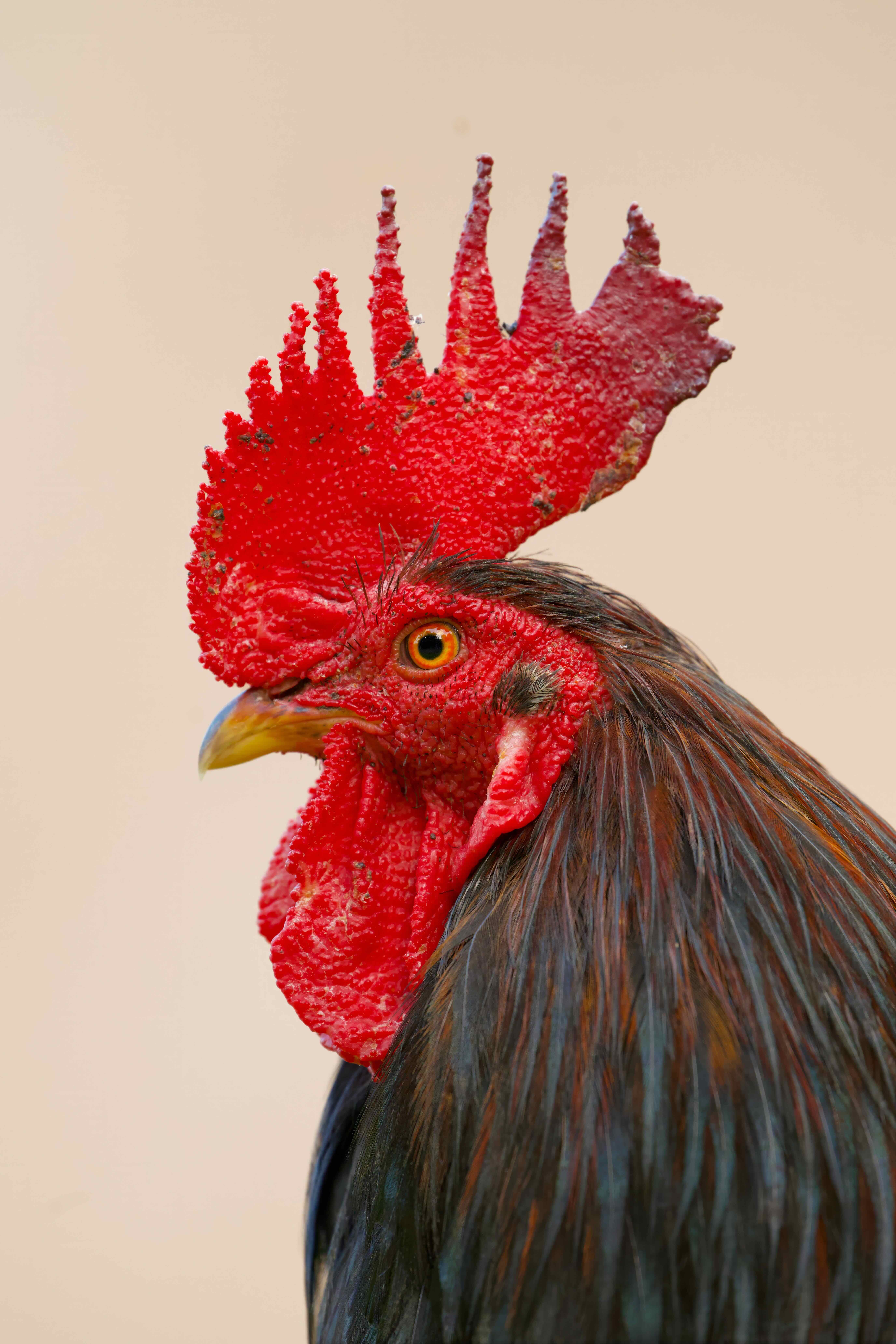
A: To eat the tarantulas.
During my recent visit to Trinidad and Tobago, a local birding guide explained that one of the reasons people commonly keep free-range chickens in their yards is to eat the tarantulas. This gave me a new respect for these domestic fowl, as I witnessed venomous tarantulas larger than my XXL-size hands, such as this female Trinidad chevron tarantula (Psalmopoeus cambridgei):

Trinidad harbors a diversity of arachnids that rivals anywhere in the Neotropics. On my night walks with my new macro lens I observed spiders (order Araneae) and harvestmen, also known as daddy long legs (order Opiliones). Both arachnids are eight-legged members of the class Arachnida, but they belong to entirely separate orders and are not closely related within that class.
Returning to the Trinidad Chevron tarantula: it constructs silken tube retreats in tree crevices, behind bark, and among epiphytic plants. It also readily adapts to human structures (e.g., tin roofs, metal pipes, and abandoned buildings) making it something of a synanthrope:

Females are large and fast-growing, reaching 18 cm (7 inches) in leg span, with striking chevron-shaped dark markings on the abdomen and green-brown coloration accented by red or orange flashes on the legs. Males are smaller, with a more uniform grey-brown appearance, and can mature in as little as one year. The species is notable for its broad diet: bats, frogs, lizards, grasshoppers, mice, and other insects have all been documented as prey.
Pharmacologically, the Trinidad chevron tarantula is of medical interest. Its venom is the source of psalmotoxin and vanillotoxin – inhibitor cystine knot (ICK) peptides that may have therapeutic applications in stroke treatment.
The pinktoe tarantula (Avicularia avicularia), is the most commonly encountered tarantula in Trinidad and Tobago. This arboreal species is named for the distinctive pink coloration on the tips of its legs in adults:
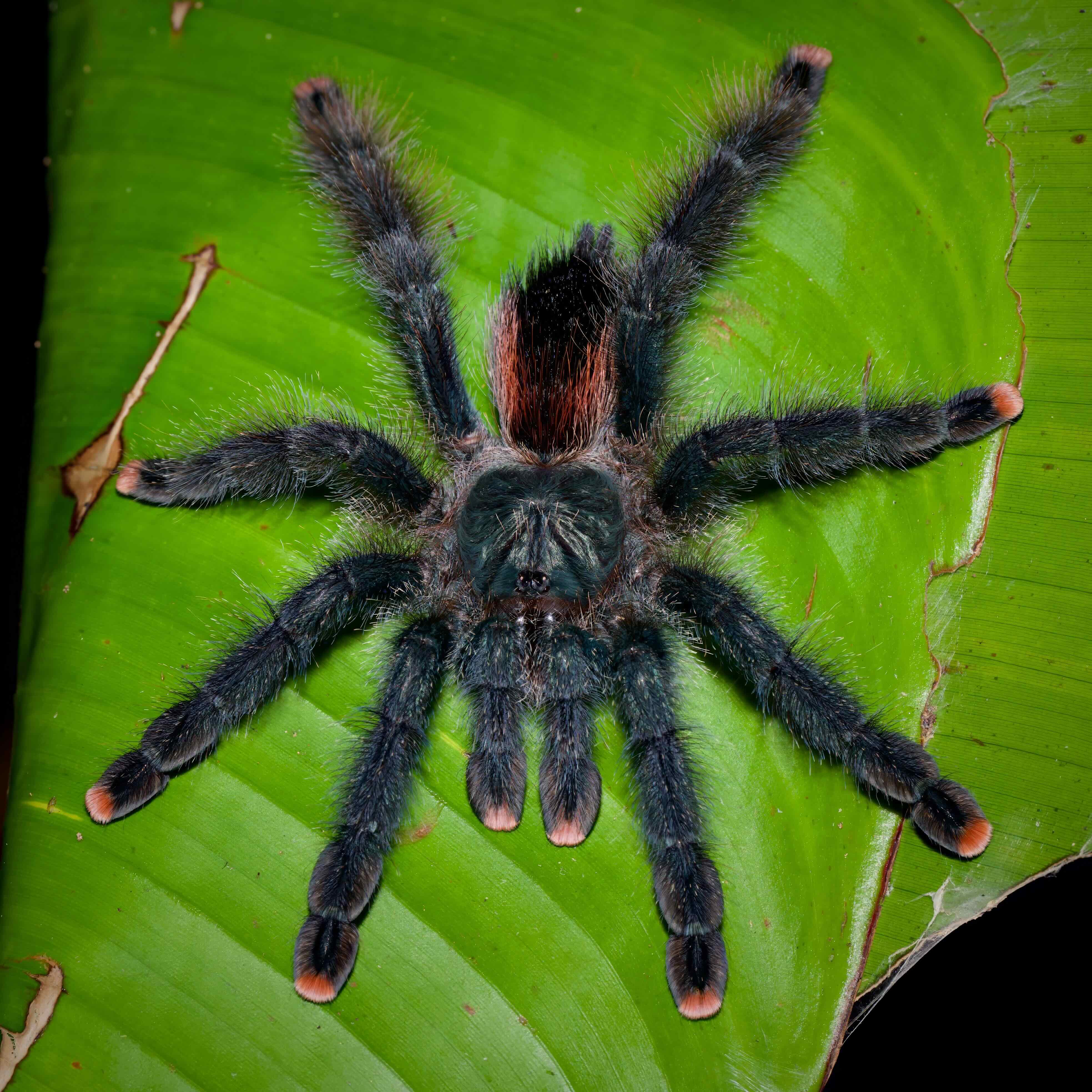
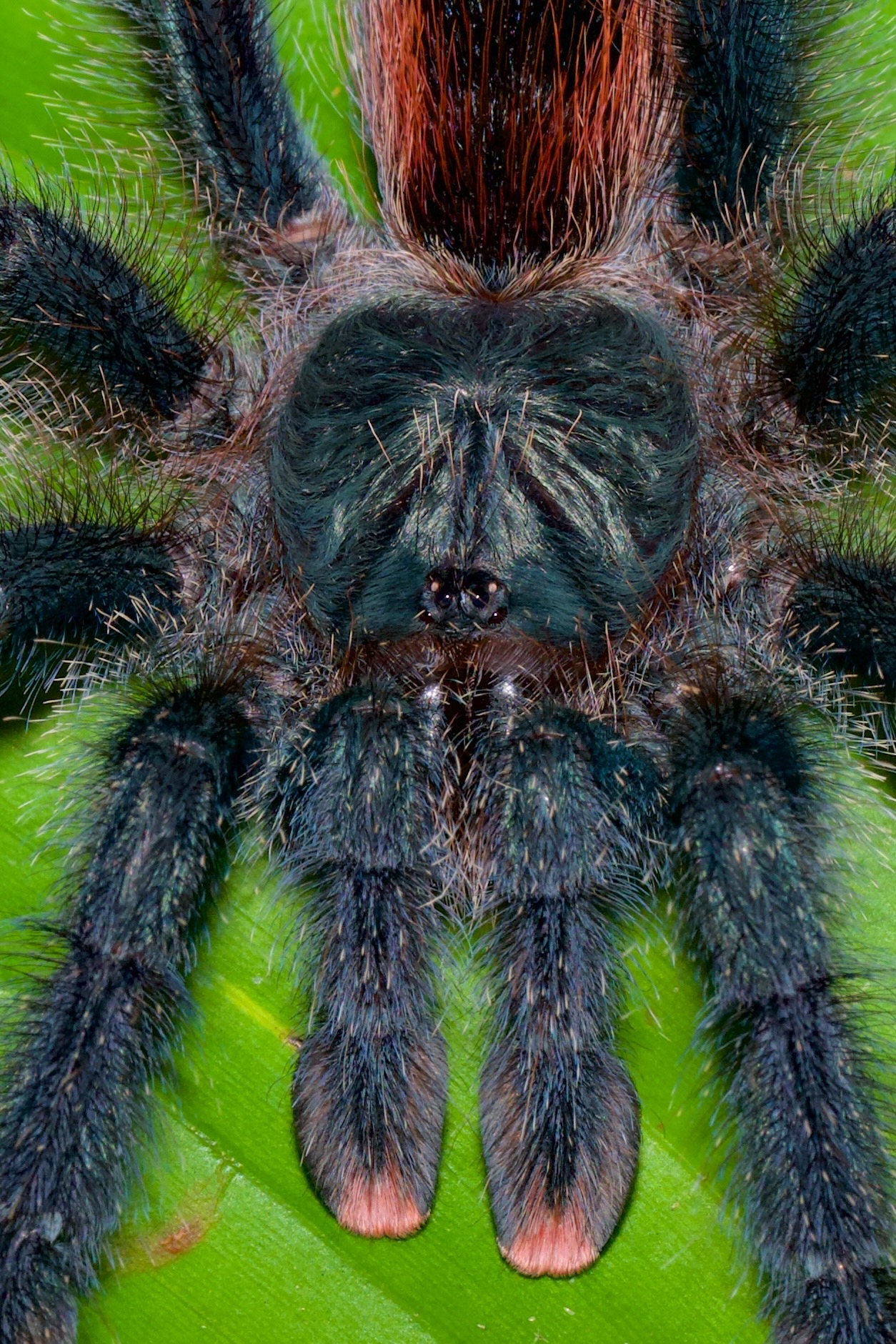
Adults reach about six inches in leg span. They are ambush predators that construct silken retreats and trip lines in tree canopies, using webbing as both trap and sensor. Unlike most tarantulas, pinktoes can jump short distances (3-4 cm), and their defensive repertoire includes propelling feces at threats, a behavior that, while unglamorous, is effective. Their venom is mild, even by New World tarantula standards. Here’s a closeup from the previous photo focused on the body:
The Giant Fishing Spider (Ancylometes bogotensis) is a semi-aquatic giant. Females reach roughly 26 mm in body length with an impressive leg span, while males are somewhat smaller at about 21 mm. These spiders walk on water using air-trapping hydrophobic hairs on their leg tips, much like water striders. When disturbed, they can dive below the surface and remain submerged for over 20 minutes by breathing air trapped in the hairs surrounding their book lungs. Their diet ranges from aquatic insects to small fish, frogs, lizards, and geckos:

Ancylometes bogotensis is sometimes confused with the infamous Brazilian wandering spider (genus Phoneutria, photo below): both are large, ground-active, nocturnal hunters with similar body plans. The name Phoneutria translates from Greek as “murderer,” and the genus has appeared in the Guinness World Records as containing the world’s most venomous spider. There are eight described species, found primarily in tropical South America with one extending into Central America.
Phoneutria species are best known for their potent neurotoxic venom, their characteristic threat display (raising the first two pairs of legs high to reveal banded leg patterns) and their wandering, non-web-building habits. They famously hide in banana bunches, boots, clothing, and dark shelters, which brings them into frequent contact with humans. Their venom contains a cocktail of neurotoxins, but fatalities are rare with modern medical treatment.
Though Ancylometes and Phoneutria were both historically placed in the family Ctenidae, Ancylometes was transferred to its own family (Ancylometidae) in 2025, reflecting the growing understanding that these semi-aquatic fishing spiders represent a distinct evolutionary lineage:

We now turn to a species of orb-weaver. The golden silk spider (Trichonephila clavipes) is one of the most conspicuous spiders in the Caribbean and Neotropical forests. Sexual dimorphism in this species is extreme: males are tiny (5-9 mm body length) and weigh roughly one-thousandth what a female does. Here is a female:

The silk itself is remarkable. It has a golden hue visible to the naked eye and is the strongest natural fiber known. Researchers have fully annotated the T. clavipes genome, identifying 28 unique silk protein genes. These spiders produce and utilize seven different types of silk. Their large, asymmetric orb webs can exceed a meter in diameter, and in the South Pacific, relatives of Trichonephila spin webs strong enough to be used as fishing nets by indigenous communities:

Project Hail Mary is a spiritual sibling to The Martian - and it's fab
What is a galaxy? That's a surprisingly difficult question to answer
Pages
