
You are here
News Feeds
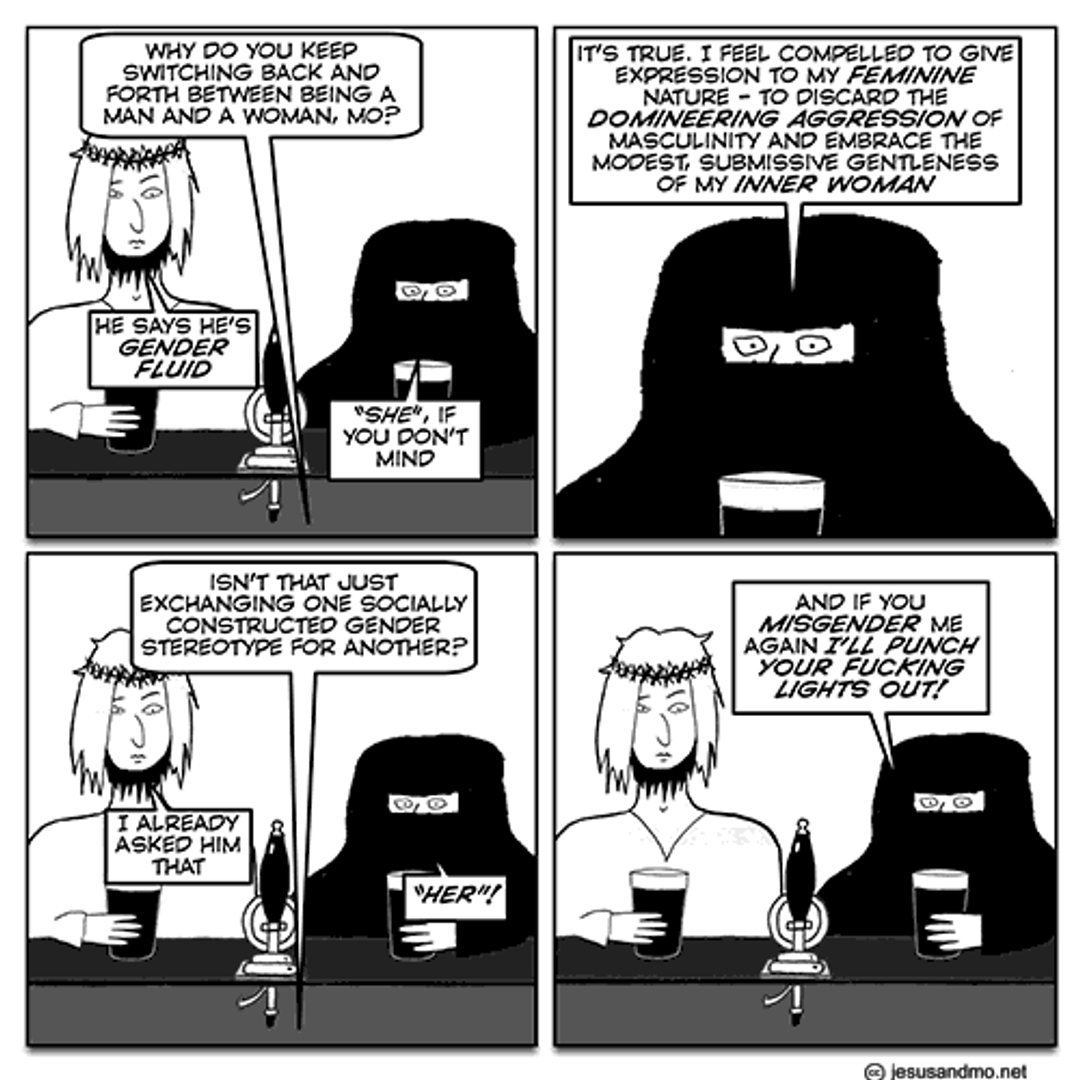
Jesus ‘n’ Mo ‘n’ gender
The Jesus and Mo artist has resurrected a strip called Fluid, called “a Friday Flashback from almost exactly 8 years ago.” It’s a classic, with Mo donning a niqab as an expression of his feminine side. Unfortunately, that side applies only to his garments, not to his temperament.
The 3 things you need to know about passwords, from a security expert
Single-celled organism with no brain is capable of Pavlovian learning
Readers’ wildlife photos
Abby Thompson, a UC Davis mathematician, is back with more photos (and a video!) from the intertidal of northern California. Abby’s captions and IDs are indented, and you can enlarge her photos by clicking on them.
Jellyfish!
I thought I’d throw some jellyfish into the lull between the great winter tides and the great summer ones.
The reproductive cycles of the tidepool creatures are wildly varied, with behaviors ranging from maternal (see Epiactis prolifera from my last post), chancy (see mussels), through incessant (see nudibranchs). But for sheer baroque complication, I vote for the jellyfish. Many who stroll on a beach will see the quivering gelatinous masses of jellyfish stranded by the tide, and the less fortunate will have encountered their stinging tentacles while in the water. This describes, a little, how they get there.
There are several jellyfish species common on the Northern California beaches; here are some of them:
Aurelia labiata (Greater Moon Jelly):

Chrysaora fuscescens (Pacific sea nettle):

Chrysaora colorata (purple-striped sea nettle) These are big, about a foot across:

Another Chrysaora colorata (handsome creatures):

Genus Aequorea (crystal jelly):


Scrippsia pacifica (giant bell jelly):

The Chrysaoras and Aurelia labiata are in the class Scyphozoa; the rest are in the class Hydrozoa.
For all of these, males and females get together in the same vicinity, and release eggs and sperm (see “chancy” above), which form little “planulae”. Then things get complicated. Because (usually) the planulae settle down and attach themselves to something, and become polyps. Like these tiny things:
Genus Sarsia:


But how do they get from here (e.g. something like Sarsia) to there (e.g. something like Polyorchis haplus)? Well they don’t, always, and sometimes they don’t get from there to here, either, but here’s an illustration of the process when it goes through a “typical” complete cycle:

And in fact if you look closely at that photo of H. bodegensis, you can see a little medusa just budding off, circled in the photo below:

Here’s a video of a set of newly-formed “baby jellyfish” (they look excited) which swam into my microscope view. I didn’t know what I was seeing, so don’t have a photo of the polyp from which they likely emerged. This means I have no idea of the genus (or even the class- if these are Scyphozoa then these are really ephyrae which will turn into medusae).
There seem to be many species for which the complete reproductive process is not documented – for example, if you search for the polyp stage of Polyorchis haplus, the answer is that we don’t know what it is, nor where it can be found.
A final oddity of this elaborate reproductive process is the existence of the so-called “immortal” jellyfish. (not found in the cold waters of Northern California). If damaged at the medusa phase, this one can revert to its earlier (genetically identical) polyp phase- and so on ad infinitum, apparently. As though, when things go wrong in your life, you could go back to your childhood and try again.
I’m grateful for help with IDs from experts on inaturalist and elsewhere. All mistakes are mine.
Why are we so suspicious of do-gooders?
Sailing the Skeptical Seas! New Orleans Escapade! Mysteries of the Maya Cruise!
Time is running out to grab one of the few remaining cabins for Málaga, Spain to Nice, France on the SV Royal Clipper AND announcing our next adventure to New Orleans followed by the Mysteries of the Maya cruise to the Yucatán Peninsula!
Learn about your ad choices: dovetail.prx.org/ad-choicesNow That It’s His Job to Control Measles, Dr. Jay Bhattacharya Suddenly Expects People to Trust Everyone & Everything He Spent 6 Years Attacking
With Dr. Jay Bhattacharya in power, the headlines now read "Americans Trust Fauci Over RFK Jr. and Career Scientists Over Trump Officials."
The post Now That It’s His Job to Control Measles, Dr. Jay Bhattacharya Suddenly Expects People to Trust Everyone & Everything He Spent 6 Years Attacking first appeared on Science-Based Medicine.The race to solve the biggest problem in quantum computing
Scientists crack a 20-year nuclear mystery behind the creation of gold
Scientists crack a 20-year nuclear mystery behind the creation of gold
Scientists built the hardest AI test ever and the results are surprising
Scientists just found a way to 3D print one of the hardest metals on Earth
A black hole and neutron star just collided in a strange oval orbit
We don’t know if AI-powered toys are safe, but they’re here anyway
ESA's Mars orbiters watch solar superstorm hit the Red Planet
What happens when a solar superstorm hits Mars? Thanks to the European Space Agency’s Mars orbiters, we now know: glitching spacecraft and a supercharged upper atmosphere.
The Case for Free Speech Maximalism
- Any group differences in outcomes can be traced to systemic racism.
- If systemic racism exists at all, it works against so-called privileged groups.
- Abortion is murder, period.
- The sanctity of human life is a made-up concept.
- Jews have a biblical right to Israel.
- Hitler was right about a few things.
- Masculinity is inherently toxic.
- If women ran the world, we would still be living in grass huts.
- The colonialists need to give back the land they stole.
- Indigenous people need to get over the fact that they were conquered.
- Providing sex is an obligation within a marriage.
- Any sexual coercion constitutes rape.
Do any of these statements resonate? Make you angry? Do some not even merit a response?
I can’t tell you exactly how I would respond to someone who defended Hitler, but I know what I would not do: stalk him on social media, contact his employer to try to get him fired, or ask my government representative to help criminalize such talk.
Does this make me a free speech absolutist? Not quite. Like Robert Jensen, a professor emeritus at the University of Austin and prolific blogger, I suspect that most people who call themselves free speech absolutists don’t actually mean it. They wouldn’t countenance speech like “let’s go kill a few Germans this morning. Here, have a gun.” Instead, Jensen writes they’re prepared to “impose a high standard in evaluating any restriction on speech. In complex cases where there are conflicts concerning competing values, [they] will default to the most expansive space possible for speech.”
In other words, they’re free speech maximalists. A more contemporary and nuanced variant of absolutism, the maximalist position grants special status to free speech and puts the burden of proof on those who wish to curtail it. While accepting some restrictions in time, place, and manner, free speech maximalism defaults to freedom of content. It aligns with the litmus test developed by U.S. Supreme Court Justices Hugo Black and William O. Douglas, which holds that government should limit its regulation of speech to speech that dovetails with lawless action:
Let’s go kill a few Germans? Not kosher.
The only good German is a dead one? Fair game.
Some pundits view this position as misguided. A 2025 Dispatch article titled “Is Free Speech Too Sacred?” laments America’s descent into an era of “free speech supramaximalism,” in which “not only must speech prevail over other regulation, but nearly everything is sooner or later described and defended as speech.” A New Statesman essay about Elon Musk, written a few months before he acquired Twitter (now X), decries Musk’s “maximalist conception of free speech usually adopted by teenage boys and libertarian men in their early 20s, before they realise its limitations and grow out of it.” The implication: free speech maximalism is an unserious pitstop on the way to more mature thinking. Only testosterone-soaked young men, drunk on their first taste of freedom, would spend more than a minute on such a naïve view.
This 69-year-old woman disagrees. I grew into my passion for free speech during the early months of the COVID-19 pandemic, when the pressure to conform in both word and deed reached an intensity I had never witnessed before. Any concerns about the labyrinthine lockdown rules elicited retorts like “moral degenerate” or “mouth-breathing Trumptard.” (Ask me how I know.)
Unexpectedly jolted into awareness of free speech principles, I began reading John Stuart Mill and Jean-Paul Sartre and writing essays about freedom of expression in the COVID era. One thing led to another, and in 2025 the newly minted Free Speech Union of Canada found a spot for me on its organizing committee. What most of us in the group shared, along with age spots and facial wrinkles, was a maximalist position on free speech. Perhaps we’re all immature. Or maybe we’ve lived long enough to understand exactly what we lose when free speech goes AWOL.
But but … critics sputter … what about hate speech? Free speech maximalism posits that you can’t regulate an inherently subjective concept. As Greg Lukianoff and Ricki Schlott note in their 2024 book The Cancelling of the American Mind, “as soon as you start legislating based on a concept as loosely defined and subjective as offense, you open the floodgates to every group and individual claim of offense.” This argument may well explain why Canada’s proposed Bill C9—the Combatting Hate Act—remains stalled after protracted parliamentary debate.
Is “you cannot change sex” hate speech or merely opinion? Is “you have a big Black butt” an offensive remark? It depends on who says it, how it’s said, and who hears it. One person may react to the big butt comment with reflexive outrage, while another may simply shrug. When said tenderly to a lover, the statement may elicit a full-throated laugh. Offense is in the eye of the beholder.
Someone can tell you that the sky is green, or that women can’t think logically, or that Hitler was right about some things, and you allow the words to bounce off your emotional core. It’s a liberating habit of mind.A case in point: In 2017, the U.S. Patent and Trademark Office refused to register the name “The Slants” (an Asian rock band) because of its derogatory, or hateful, connotations. The bandleader sued and the Supreme Court ultimately agreed that “giving offense is a particular viewpoint” and a law restricting expression on the basis of viewpoint violated the First Amendment.
Here’s the thing: when you embrace viewpoint diversity as an ideal, you tend to get less offended about things. You may profoundly disagree with a statement, but it won’t cause you to puff up in outrage. Someone can tell you that the sky is green, or that women can’t think logically, or that Hitler was right about some things, and you allow the words to bounce off your emotional core. It’s a liberating habit of mind.
And if you do get offended? Big whoop. You’ll survive. During a recent bus trip from Whistler to Vancouver my seatmate, a doctor, took it upon himself to share his candid opinions about women with me: they can’t take a raunchy joke, they make poor leaders, they’re responsible for cancel culture, and society would work better if they stayed home. Ugh. Seriously? But I survived. I wasn’t traumatized. Truth be told, I quite enjoyed our conversation. He listened as much as he spoke. I even found a few grains of value in his arguments, and perhaps a couple of my retorts gave him pause. And that’s what it’s all about, isn’t it? Humans of all stripes challenging and learning from each other.
Here I must pause to express disappointment in my own sex. Women, I have found, value free speech less than men do, and studies corroborate my perception. In one survey, 71 percent of men said they gave priority to free speech over social cohesion, while 59 percent of women held the opposite view. An article reporting on the survey affirmed that “across decades, topics, and studies, women are more censorious than men.” Boo.
Even with carte blanche to express ourselves, it’s impossibly difficult for us humans to lay bare our true thoughts. Self-censorship is baked into our DNA. Free speech maximalism serves as a counterweight to this force. It allows us to rise, even if timidly, above the lead blanket of social conformity flung over us by the finger-wagging classes. By exposing little bits of our true selves, we shed light on the glorious contradictions in the human condition—a benefit that serves not just angry young men, but women with age spots and everyone else.
To those concerned about the dangers of loosening our tongues, I offer Greg Lukianoff’s bracing maxim: “You are not safer for knowing less about what people really think.”
This Isn't Just Another Rocky World Orbiting a Red Dwarf. This One's Special
Rocky planets are found in abundance around M-type stars (red dwarfs), so finding another one doesn't always generate headlines. But an international team of astronomers say that one recent M-dwarf rocky planet found by TESS is especially noteworthy. This one can serve as a benchmark for comparative studies of this type of exoplanet and their at-risk atmospheres.
Scientists Find Evidence of Worlds Colliding ... 11,000 Light-Years Away
Astronomers say unusual readings from a star system 11,000 light-years away suggest that two of the planets circling the star crashed into each other, creating a huge, light-obscuring cloud of rocks and dust.
Only A Supercomputer Can Understand the Extremely Energetic Chaos of a Neutron Star Merger
A neutron star merger is an extraordinary event. It features extremely powerful, chaotic magnetic fields that generate extremely energetic photons. Supercomputer simulations show that the extreme gamma-ray photons created in the mayhem can't even escape the chaos.
How worried should you be about your BMI?
Pages
