
You are here
News Feeds
Bill Maher’s latest New Rule: “Trump Estrangement Syndrome”
Bill Maher’s latest news-and-comedy shtick on “Real Time” deals once again with the flak he got for having dinner with President Trump. Remember? Despite Maher constantly criticizing the President’s policies durin gthe dinner, he also reported that he found Trump affable and friendly.
That was enough for liberals to come down on Maher like a ton of bricks, despite the fact that he simply gave his reaction. Trump’s policies were reprehensible, Maher averred, but he was a good host. In today’s world that will do you in. Larry David, for instance, wrote a satire of Maher’s reaction in a NYT op-ed called “Larry David imagines a private dinner with Hitler” (archived here), and I imagine that pissed off Maher.
Apparently Trump posted about his dinner with Maher on Truth Social (on Valentine’s Day), and Trump’s post was full of lies (surprise!). Here Maher corrects the record, and gets a few shots back at Trump for lying, while calling out people with true “Trump Derangement Syndrome.” (“Get a life: stop making him your whole personality”.) But he adds that Trump bears some responsibility for promoting TDS because his racism, misogyny, anti-democratic acts, and corruption “make people crazy.” Maher further also ticks off a few good things that Trump did, including asserting that “penises don’t belong in women’s prisons,” which will simply anger “progressives” more. Maher argues that he may be “the last person from the Lunatic Left that is still an honest broker when it comes to Trump.”
Maher winds up addressing Trump directly, calling him out for his many detestable acts—after he’s given the President plaudits for some things. Yes, Maher seems defensive here, but he’s honest and I still like the guy. I don’t have much truck with people who say that Trump never did anything good, and, in fact, it’s impossible for that to happen.
Bill’s guests were Rep. Adam Schiff (D-CA), journalist Don Lemon, and author Annabelle Gurwitch/
The story of our Big Dinner will appear tomorrow
As I mentioned yesterday, Robert Lang invited me to dinner last night at a famous Chicago restaurant called Next, whose metier is mulitcourse menus with a theme. And they completely change the theme every four months, so they’re always working on and testing the dishes to come (see the history of the themes at the Wikipedia link given in the first sentence). The theme of our meal was “Japan,” inspired by the restaurant chef, manager, and some staff having taken a trip to Japan to absorb the food and culture. They they returned to the U.S. and worked for a few months to develop dishes that were not explicitly Japanese, but inspired by the food they tried in Japan.
While preparing the account of our meal for a post, I realized that it is going to take some time, what with 12 dishes and 8 wines (including 2 sakes), as well photos of the menu and the restaurant. I will say now that it was one of the best meals I’ve had in America—even better than the vaunted French Laundry in California, where years ago I paid a lot for a disappointing meal.
We managed to get into this restaurant, which has a huge waiting list, because Robert’s niece is the general manager; and because of that we got a few gratis dishes.
The meal was terrific, with a largesse of small, lovely, and wonderful dishes and thoughtful and appropriate pairings with wines and sakes. The meal did not fail where many of small-dish places do: making you leave when you haven’t had enough to eat. This was not the case at Next: I left dazzled, sated, and a bit buzzed.
I will ask your indulgence because it will take me a few hours to crop the photos, insert them in a post in the proper order, and try to describe the dishes from a memory clouded by sake. The post will be up tomorrow morning.
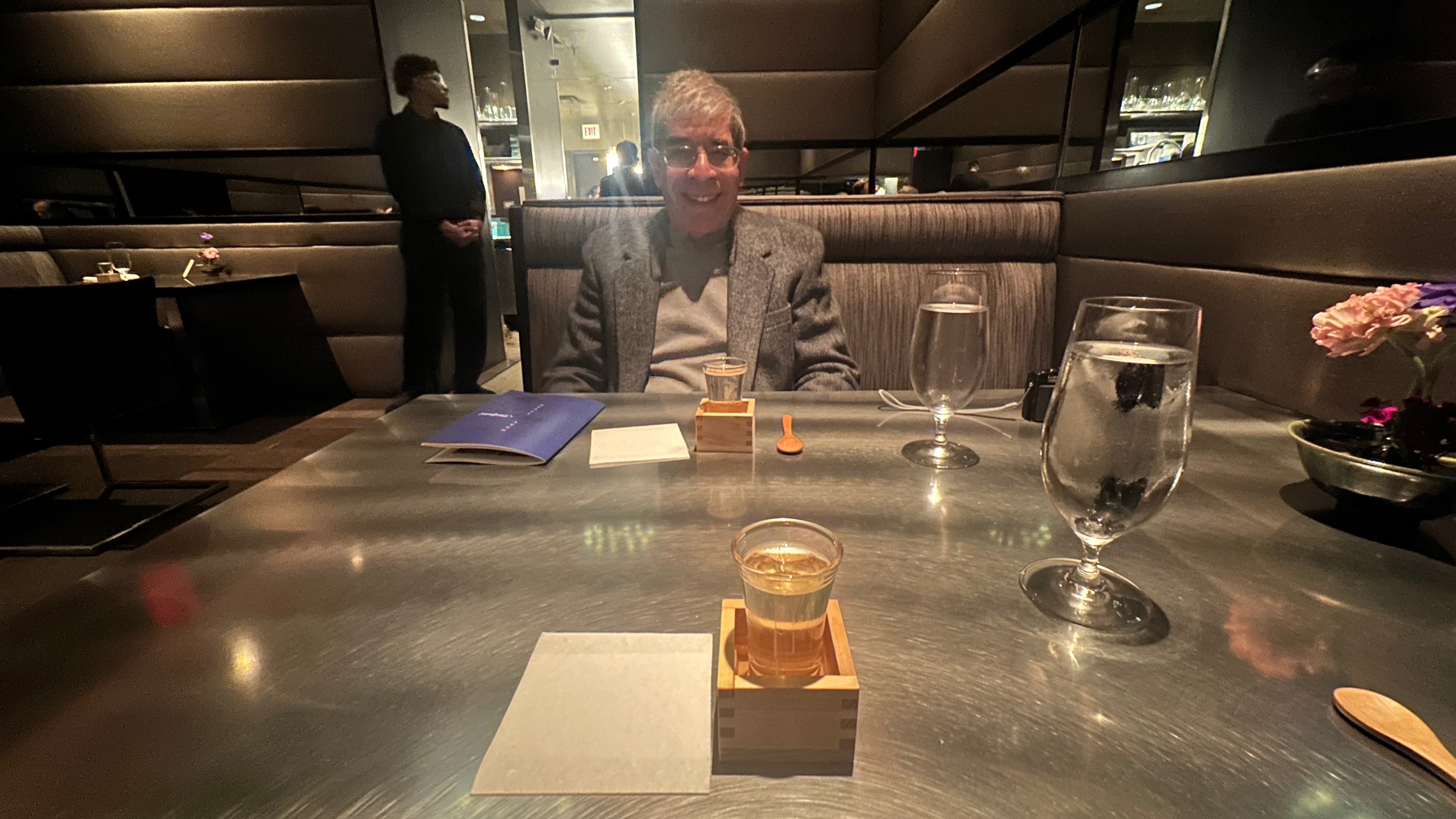
To wet your whistle, here’s a photo taken by Robert, showing the introductory tipple, a glass of sake poured to overflowing inside a cedar box. This is traditional: you sip the full glass until it can be poured into the box, and then drink the rest from the box, which lightly flavors the sake with cedar. This was also a rare form of sake for me: a sparkling one.
All will be revealed tomorrow. Right now I am recovering.
Caturday felid trifecta: What not to do to your cat; Jock(s) the Chartwell cat(s); missing cat in England found in Paris, more than 8 years later; and lagniappe
We have three cat items and lagniappe today.
This first video was made by Meowtopia, the same people who made the informative video on cat psychology that I posted recently. Here we have 18 minutes of advice about what not to do to your cats: nine human behaviors that adversely affect cats based on their evolved natures.
The list: failure to greet the cats when you come home; using a laser pointer or other toy that a cat cannot catch (this is a no-no as it violates the predatory sequence that ends with a kill), petting in the wrong places, invasion of a cat’s territory, punishment of trangressing cats by squirting, yelling, or striking them (this conditions them to fear you; the solution is to prioritize a better option), afflicting them with loud noises (their hearing is absurdly sensitive), failure to understand their communications and to respond to it (feral cats don’t meow), picking them up and thrusting them into the hands of a stranger), and, finally, assailing their sensitive vomerine scent-detection system with strange smells like heavy perfumes or air freshener and, worst of all, scented cat litter.
This is a very good and educational effort, not simply a cute cat video. Even if you have a cat, do watch it.
*********************
Winston Churchill was a huge fan of cats, as you can see from this National Trust post below about the lineage of orange (“marmalade”) cats that still roam the grounds of Churchill’s old home, now given to the country. As Wikipedia says in its article about Winston Churchill’s pets (my bolding):
Churchill had many cats in his life, both at Chartwell and in government service. At Chartwell, these included a tabby, Mickey, and a “marmalade colored” cat named Tango. Tango was there in the 1930s and 1940s and appears in anecdotes about those years. But Churchill’s most famous wartime cat was Nelson who was initially a mouser at the Admiralty when Churchill was First Lord. Churchill named him Nelson after the great admiral after seeing the cat chase a large dog away. He then took the cat with him to 10 Downing Street when he became prime minister, where it also chased Chamberlain‘s cat, the Munich Mouser.
In later life, he was given a cat by Jock Colville for his 88th birthday. This was a ginger cat with white markings that he called Jock too. This cat became a favourite in his final years. When he died and Chartwell was donated to the National Trust, the family asked that a marmalade cat with white bib and socks called Jock should always be maintained there. This tradition has continued and Jock VII became the current holder of this position in 2020.
Chartwell was Churchill’s country home in Kent to which he retreated again and again, even when he moved 10 Downing Street as Prime Minister. Click to read about the two living Jocks:
. . . Generations of ginger cats have lived at Chartwell over the years. Since the National Trust opened the house to the public in 1966, the family of Sir Winston Churchill requested that there always be ‘a marmalade cat named Jock, with a white bib and four white socks, in comfortable residence at Chartwell’.
Here are the last two Jocks that are still alive, though Jock VI retired and, nearly blind, lives with a staff member (see short video below).
Jock VII
In May 2020 Chartwell welcomed Jock VII, a six-month-old rescue kitten, to take up this unique role.
Along with his white bib and white paws, Jock VII has a very mischievous character. His favourite pastimes are investigating what the gardeners are up to and playing down in the long grasses of the orchard. He also likes lots of cuddles on the sofa after an eventful day.
Keep an eye out for him as you tour the property.
Rescued
Jock VII, previously known as Sunshine, was rescued by the RSPCA before being adopted by one of the team at Chartwell.
He was rescued along with 30 other cats from squalid conditions. The kittens were very weak and undernourished but were young enough to be brought back to health quickly. Jock was the most confident of the whole group and was already playful and full of fun.
Jock VI
Jock VII’s predecessor, Jock VI, came to Chartwell in 2014. Sadly, he became almost completely blind and was finding life at Chartwell difficult. After his six years of service, he retired and is now enjoying a much quieter and more peaceful life with a member of staff in a garden of his own.
Here’s Jock VI with his staff; she seems quite loving:
*********************
Finally, from an author called Sean, we have a Medium story about his cat Moon Unit (you may remember that this was the name of Frank Zappa’s daughter, born in 1967).
Click on the link below to go to the story of a latter-day Moon Unit, a cat who went missing from London and turned up in France, toothless but otherwise okay, 8½ years later!
An excerpt:
A few years passed and we had a new year’s party. The next morning we discovered we had one cat missing. Moon Unit had somehow got out during the party and disappeared. We went out looking, printed out posters, told the local cat rescue places, but no luck. People told us about lots of little black and white cats they’d seen, but none of them had MU’s distinctive white nose or big whiskers. So no luck. And we were very sad.
But about a month ago, out of the blue, I got an email from the Kennel Club saying that a cat with a matching microchip had been found. IN PARIS. Now if that isn’t boggling enough, that party was EIGHT AND A HALF YEARS AGO. We exchanged photos with the French rescue place, and it was definitely Moon Unit. Distinctive nose and whiskers as I said. And she has that fur that is dark on top but white underneath.
She had been found wandering around outside a train station in a French suburb, and taken to a cat rescue place, who checked her chip and got in touch. Well, the chip contact details were a bit out of date (did I mention EIGHT YEARS missing?), but the French people were very stubborn and eventually the KC used newfangled email to get in touch with me.
So this weekend we went over to Paris. In the past few weeks, Moon Unit had been checked at the vet, and given rabies shots and worming tablets, and a Pet Passport organised for her. Two lovely ladies came over to our hotel with her on Saturday (we gave them some chocolates and flowers), and we took her to Calais by train (telling her story to the people around us), and our friends met us at the station and drove us onto the car ferry, and back to London. (There aren’t many foot passenger services that take pets).
.. . .Back in London we closed all the doors and let Moon Unit out into the hallway. She had a look around, and seemed perfectly fine. I spent the rest of the evening in the hallway with her, and she’s been following me around all day. She’s not been doing that “OMG new place I must HIDE” thing that cats often do — in fact she’s curled up next to me on the sofa as I write this. (Remember she only got back yesterday).
So there we have it. A tale of European cooperation and perseverance and international mystery. How did Moon Unit get to PARIS? How has she survived for over EIGHT YEARS? How did she lose all her teeth? Has no vet checked her chip in all that time? Answers we will never get, until she writes her mewmoirs.
. . . And the moral of the story — always get your pets microchipped and keep the contact details up to date, even if they are indoor pets. Moon Unit was an indoor cat while she was with us. Hope you enjoyed reading this.
Here’s a photo labeled “Moon Unit back in the day,” presumably taken by Sean.

********************
Lagniappe: Here’s a two-minute cat version of Indiana Jones: “Indiana Jonesy” in “Raiders of the lost treat.” You will remember some of the scenes. No cats were injured in the making of this film.
h/t: Matthew Cobb,
Gentle Reminder: Daylight Saving Time Starts Tomorrow
As a gentle reminder that you will have an hour of sleep robbed from you tonight, enjoy this episode on Daylight Saving Time Myths from the archives!
Learn about your ad choices: dovetail.prx.org/ad-choicesHow an intern helped build the AI that shook the world
The moment that kicked off the AI revolution
Antarctica has a strange gravity hole and scientists finally know why
Physicists finally see strange magnetic vortices predicted 50 years ago
VLT Image Captures a "Cosmic Hawk" Spanning its Wings.
Today’s Picture of the Week, taken with ESO’s Very Large Telescope (VLT), seems to have captured a cosmic hawk as it spans its wings.
NASA changed an asteroid's orbit around the sun for the first time
Chemistry clues could detect aliens unlike any life on Earth
Inflammation might cause Alzheimer's – here's how to reduce it
Possible brief slowdown in posting
I need a life—even if that is a life outside of writing for this website. That’s by way of informing you that posting here may be a bit light for about a week. I have a writing assignment, which is to answer Michael Shermer’s response to my own post on this site taking issue with his claim (also in his new book Truth) that we have a form of free will. (My response will appear at Skeptic.) I can do no other than answer a form of compatibilism that gives us free will simply by redefining the folk notion of free will in an un-refutable way so that that we do have free will even if all our behaviors and thoughts derive from and are compatible with the laws of physics. But I digress.
My second task is to go shopping for much-needed Chinese groceries (I ran out of everything during the cold spell), but, most important, to meet my friend origami master and engineer Robert Lang, who’s invited me for splendid dinner at Next. Next is a sister restaurant of Alinea—surely one of America’s most famous restaurants. Next is equally highly rated. Both Next and Alinea are run by the same chef, Grant Achatz (see a Facebook interview with him here). Robert’s in town for an origami convention, and the trip to Next is prompted by his rare appearance in Chicago and the felicitous fact that Robert’s niece happens to be the general manager of Next. I think that’s how we got reservations given that the site says, “On any given night, there can be 10,000+ guests on our waitlist.”
Next is so named because it changes menus to a new theme every few months. This most recent theme is Japan, and I have the menu, which has nine courses that look fabulous (Earlier, Robert provided some origami for the menu.) I’ll save the food experience for a post (with photos) tomorrow or Sunday. There will also be a wine pairing with the many courses, and I’m sure that a great and bibulous time will be had by all.
Stay tuned. As always, I’ll do my best, both at table and at this site. Oh, and don’t forget to set your clocks forward on Saturday night.
The best new popular science books of March 2026
Shift in the Gulf Stream could signal ocean current collapse
Matthew Cobb wins big prize for his Crick biography
I told you that Matthew’s new biography of Francis Crick was good! Now Crick: A Mind in Motion has been given the imprimatur of quality by winning a big book prize in England. Matthew sent me his Bluehair post below, and when I asked him what prize he won, he replied:
Hatchard’s First Biography Prize. Hatchards is a posh bookshop on Piccadilly where the King buys his books. I will get a proper cheque. £2.5k!
It is a big check—in both senses:
I won! I have a big cheque!
— Matthew Cobb (@matthewcobb.bsky.social) 2026-03-05T19:23:03.888Z
Below is the site for the prize (click to go there). Note, too that Matthew’s book beat out the John & Paul: A Love Story in Songs, a book about Lennon and McCartney and Careless People: A Cautionary Tale of Power, Greed, and Lost Idealisme, a kiss-and-tell memoirSarah Wynn-Williams, who used to work for Facebook and who has been clobbered with lawsuits by that company and other people.
And the site’s announcement:
Hatchards has teamed up with The Biographers’ Club to support the Best First Biography Prize.
The prize awards £2,500 to the best biography or memoir published that year, and has been won in recent years by Daniel Finkelstein, Katherine Rundell and Osman Yousefzada, Lea Ypi, Heather Clark, Jonathan Phillips, Bart van Es, Edmund Gordon and Hisham Matar.
This year’s winner is Crick by Matthew Cobb.

Go buy it, or take it out from the library to read it. (This advice is for people who are interested in science, but if you’re not, you shouldn’t be reading here.)
Congratulations to Matthew! I told him to use the £2500 prize to treat himself to something nice, like a vacation.
Making New Solar Activity Connections From Old Data
It’s tough sometimes, living with a tempestuous star. Modern human civilization and technology lives at the whim of the Sun, as it sends solar storms and punishing coronal mass ejections our way. And while we understand the overall pitch of the 11 year solar cycle, it's hard to predict exactly what the Sun is going to do next. Now, a recent study has reached back and examined over a century of solar observations, in an effort to make more accurate near-term predictions of solar activity.
Readers’ wildlife photos
Reader Todd Martin sent some photos from the Yucatán (don’t miss the Ocellated Turkey!). Todd’s captions are indented and you can enlarge the photos by clicking on them.
WEIT Yucatán
Here are some photos from a trip in November to the Yucatán in Mexico. The original purpose of the trip was to see Mayan ruins, but the natural beauty of the area turned out to be equally remarkable.
The first few pictures were taken during a boat tour of the mangroves in the Ría Lagartos Biosphere Reserve along the northern coast of the Yucatan Peninsula. The tour began at dawn and we were greeted by the rising sun and a welcoming committee of Monohelea maya, a species of predaceous midge discovered with some fanfare by scientists in 2000 (and with somewhat less fanfare on this very morning by myself):

The reserve is home to many species of birds, the most famous of which is the American flamingo (Phoenicopterus ruber), which can be observed trawling for brine-shrimp in the brackish water:

This is a Magnificent Frigatebird (Fregata magnificens). The male is easily recognized by the bright red throat pouch which looks like a life vest when inflated but actually serves to attract females. The females can be recognized by their frequent calls of ‘Well, if you’re so magnificent why can’t you take out the trash’:

The largest avian species we saw was this haughtily regal Brown pelican (Pelecanus occidentalis):

This is a Neotropic Cormorant (Nannopterum brasilianum) a diving bird sometimes used by the indigenous people of Bolivia and Peru to catch fish:

Hopefully this Wood Stork (Mycteria americana) has a good personality because it is (as my grandmother might have quipped) ‘not conventionally attractive’. It is, however, the only native stork in North America:

The Osprey (Pandion Haliaetus) is sometimes known as a fish hawk because fish make up the majority of its diet (not unlike Kevin Bacon or the singer Meatloaf):

Some birds are naturally elegant like this Great Egret (Ardea alba).In case you want to know how to avoid confusing it with a Snowy Egret … a Great Egret has a yellow bill and black feet, while the smaller Snowy Egret has a black bill and yellow feet:

Green Heron (Butorides virescens). Here’s a fun fact I cribbed from Wiki: “Green herons are one of the few species of bird known to use tools. In particular, they commonly use bread crusts, insects, or other items as bait. The bait is dropped onto the surface of a body of water to lure fish. When a fish takes the bait, the green heron then grabs and eats the fish”:

This American White Ibis (Eudocimus albus) was quite accustomed to people, which allowed me to get a pretty good close-up:

Morelet’s crocodile (Crocodylus moreletii). They look somewhat fearsome, but our one-armed tour boat operator said this one was ‘practically domesticated’”

Yucatan Jay (Cyanocorax yucatanicus) Jays are the noisy, argumentative neighbors of the animal kingdom. They are often described as ‘gregarious’ which I take to mean that they’ll take food from your plate without asking:

Those who frequented Glamour Shots in the 1980’s might confuse this photo with others of the genre, but it’s an Ocellated Turkey (Meleagris ocellata). The bird was the original inspiration for the marketing tag-line ‘taste the rainbow’. Unfortunately the bird is considered ‘Near Threatened’ by the International Union for Conservation of Nature (IUCN) with numbers that are sadly on the decline:

Whoever named the Black Spiny-tailed Iguana (Ctenosaura similis) wasn’t particularly creative, but I’m inclined to give them a pass because … that spiny tail!:

Finally – we stopped by Florida before returning home and my wife couldn’t resist adopting one of those hairless sphynx cats from the local shelter (Alligator mississippiensis). We love him very much, though he does have the unusual habit of sleeping in his water dish:
The 4.6-Billion-Year-Old Tape Recorder Hidden Inside Asteroid Dust
Asteroids are critical to unlock our understanding of the early solar system. These chunks of rock and dust were around at the very beginning, and they haven’t been as modified by planetary formation processes as, say, Earth has been. So scientists were really excited to get ahold of samples from Ryugu when they were returned by Hayabusa-2 a few years ago. However, when they started analyzing the magnetic properties of those samples, different research groups came up with different answers. Theorizing those conflicting results came from small sample sizes, a new paper recently published in JGR Planets from Masahiko Sato and their colleagues at the University of Tokyo used many more samples to finally dig into the magnetic history of these first ever returned asteroid samples.
Earth is now heating up twice as fast as in previous decades
Pages
