
You are here
News Feeds
The Answer is Written in the Stars
Astronomers have turned to some of the oldest stars in our Galaxy to tackle one of cosmology's most stubborn puzzles and their answer might surprise you. By analysing precise age data for more than 200,000 Milky Way stars, researchers have placed the age of the universe at around 13.6 billion years. It's a deceptively simple idea that the universe cannot be younger than the stars it contains. What they found doesn't just give us a number, it adds a compelling new dimension to a decades long argument that has divided the scientific world.
Columbia’s anti-Israel grad student union makes big demands, prepares to strike
Graduate student unions are relatively new: they weren’t around when I was in graduate school in the Pleistocene. They are officially part of larger labor unions (the University of Chicago grad student union, for example, is part of the United Electrical, Radio, and Machine Workers of America (GSU-UE, Local 1103). Today’s piece is about the Columbia University grad-student union, affiliated with the United Auto Workers.
The rationale for students joining unions is that they consider themselves employees rather than just students, and that comes from requirements that students often have to teach to get their degree (they can be paid by the university if they’re on fellowship, as I was at Harvard, and taught for a year as part of the degree requirements). Teaching and even the requirement to do research is considered “employment” in the same way that making cars is considered employment, though many grad students disagree, considering their activities involved in getting a graduate degree—including learning to teach—to be education, not employment. The resolution of these differences involves grad students voting: if enough of them want a union, they get a union. Whether or not they must join a union or pay dues to a one depends on the university. Neither Chicago nor Columbia requires membership, for example, but the benefits all students get are those agreed on via bargaining between the university and the union. Chicago grad students have to pay someone, however. As Grok tells me:
University of Chicago graduate students are not required to join the union (GSU-UE) as members. However, those in covered teaching or research positions must pay union dues or an equivalent agency fee as a condition of employment, per the collective bargaining agreement effective April 2024. I’m not sure who gets the “equivalent agency fee.”The two articles below, the first from the Free Press (FP) and the second from the Columbia Spectator (CS; the student paper) describe a potential upcoming strike by Columbia graduate students. Click on either headline to go to the article. I’ll identify where quotes come from, and all quotes are indented.
The CS describes how grad-student unions bargains with the university; this holds, I think, for all universities:
Under the National Labor Relations Act, the union’s legally mandated role involves bargaining with the University over wages, hours, and working conditions, which are ‘mandatory’ subjects of collective bargaining; the employer and the union are legally required to bargain over these subjects if one of the parties raises concerns. Other topics which may be brought for bargaining include any condition outside of wages, hours, and working conditions. Neither party may insist on bargaining for permissive demands, but they may discuss them.
One of the problems with requesting big increases in student salaries, as Columbia’s union is doing, is that it ultimately leads to the admission of fewer grad students, for the funds for grad students are limited. (This shrinking has happened, I’m told, at the University of California.) Another problem, highlighted in the FP but not the CS article, is that student unions, which have historically taken political stands (including endorsing candidates), can and have made demands for the university itself to take political stands. In the case of Columbia, this often involves anti-Israel stands, and you can see that many students—especially Jewish ones—don’t want to be part of a union that is explicitly and blatantly anti-Israel.
The FP article (not archived):
And the CS:Columbia students went on strike for 10 weeks in 2021, and that of course degraded classes in which grad students teach, and also research (nobody is supposed to teach or do research during a strike). Now they’re threatening to strike again, and the union’s demands are big. From the CS:
The Student Workers of Columbia-United Auto Workers [SWC] opened a strike authorization vote Friday to “ramp up the pressure” for the University to meet its demands amid seven months of stalled contract negotiations.The vote follows continued disagreement between the union and the University over the scope of issues subject to collective bargaining and is open to all union members through March 8. If affirmed, the vote would authorize union leadership to hold a later vote to decide whether and when to initiate a strike. SWC-UAW last went on strike in 2021 for 10 weeks during its first contract negotiation before signing a contract with the University.
A University spokesperson characterized the strike authorization vote as “disappointing” in a statement to Spectator because it comes “after only six bargaining sessions and without even putting forward all the proposals they have said they want to discuss with the University.” “During negotiations for SWC’s first contract in 2021, Columbia met with the union 73 times before they decided to strike,” the spokesperson wrote.Here’s what Columbia students get now and what they’re asking in terms of benefits (from the FP):
Now that the union has gotten around to its economic demands, they are far beyond what graduate students at comparable academic institutions are typically offered. On top of a full tuition remission valued at over $55,000 per academic year, SWC has demanded an annual minimum salary of over $76,000 for PhD students who are teaching or conducting research, even though they are expected to work only about 20 hours per week.
The union also is seeking a childcare subsidy of up to $50,000 per child per year. For so-called casual employees, including undergraduate student workers, the union is demanding minimum pay of $36.50 per hour, up from $22.50 per hour, and more than twice New York City’s minimum wage of $17 per hour.
SWC also plans to bargain for union shop status, which would force student workers to join and pay dues to remain employed, or for agency shop status, in which nonunion members must pay a fee to cover bargaining costs.
Some Googling indicates that grad students now make up to about $50,000 per year, so they’re asking for about a 50% increase in salary. And depending on whether a member has kids, the demands could total as much as $200,000 per year. Further, the “union shop status” they’re requesting means that all students must join the union, and since the union is demanding political stands, that can be problematic. From the FP:
The battle isn’t primarily about wages or working conditions. Instead, it is focused on the demands of anti-Israel activists on Columbia’s campus. Some student workers say this activism means that they feel uncomfortable about seeking help with basic functions like workplace conditions or health insurance.
“They’ve singularly focused on pursuing policies that are meant to disenfranchise Jews and Israelis, as opposed to pursuing and negotiating on policies for the betterment of all student workers,” one Columbia grad student told me. An engineering graduate student added, “If you look at what the union is doing now, you can see there’s no sane people left.”
SWC’s president, Grant Miner, isn’t even allowed on campus. He was one of the 22 students arrested following the occupation of Hamilton Hall in 2024, was expelled, and therefore is no longer employed by the university. Yet Miner is paid over $46,000 a year by the union, according to a contract reviewed by The Free Press. Miner did not respond to a request for comment.
Some of the Columbia union’s demands (from the FP):
The union has demanded that Columbia public safety officers not “use force against Columbia affiliates or non-Columbia affiliates under any circumstances,” carry weapons, or require anyone to show their university identification. SWC also wants Columbia to dismantle its security cameras, halt Columbia’s dual degree program with Tel Aviv University, block the opening of a new facility in Tel Aviv, and divest Columbia from Israel.
. . .Olya Skulovich, who is Jewish and Israeli, said SWC deserves credit for improvements in health insurance and other areas. “There was not even coverage for spouses” when she started, said Skulovich, who arrived at Columbia in 2018 and earned a PhD in earth and environmental engineering.
But she was shocked when the union quickly veered away from economic priorities after Hamas attacked Israel on October 7, 2023. SWC described Israel as “genocidal” and called on Columbia to divest from the “Israeli war machine.” The statement was approved by just 100 of the eligible union members.
“I lived a big part of my life in Belarus, and I know what antisemitism is firsthand,” Skulovich said. Brian Frost, a union steward for the engineering school, resigned from his SWC post over the post–October 7 statement. “The lists of demands are not labor demands,” he wrote in an email to other PhDs in his department. The statement was “uncharacteristically heartless for a labor organization,” said Frost.
Once the union had taken an official side on the war in Gaza, it began to support student protesters. SWC voted to join the Columbia University Apartheid Divest (CUAD) coalition, the main anti-Israel campus group that includes Students for Justice in Palestine (SJP) and Jewish Voice for Peace (JVP). The three groups are not recognized by Columbia and were therefore ineligible to organize protests, but union leaders believed that SWC could veil their activities as labor actions.
“We were putting up rallies for the student organizations who weren’t allowed to protest on campus,” union steward Ioanna Kourkoulou told other UAW branch organizations. She bragged that SWC was “allowed to picket whenever the fuck we want.”
I have never been involved in any of these negotiations or votes, as I was a faculty member when the union began at my school, and I can’t even tell you what deal was made between the union here and the university, though I doubt it forces the University of Chicago to take political stands, which is prohibited by our Kalven principles.
I thus can’t say how many grad student positions here have been lost here because of bargaining, but if the Columbia union gets its demands of a $76,000 annual salary and childcare subsidies (on top of the $55,000 tuition remission), I expect there will be substantially fewer grad students. That is for the talks to decide.
What I most object to is the union’s anti-Israel demands, which include university divesting from Israel, blocking the Tel Aviv facility, and joining three anti-Israel groups (and sponsoring their rallies)—at least two of them (SJP and JVP) that I see as antisemitic. This would force Columbia to take ideological and political stands, which would violate its existing policy of institutional neutrality and chill the speech of Jewish or pro-Israel students. It is the political positions of grad-student unions that, I think, make them different from “normal” labor unions and inappropriate for universities. Whatever Columbia decides to do about grad-student funding, it must not agree to adopt these ideological positions.
How our ancestors used mushrooms to change the course of human history
Mystery 'whippet' space explosion is the brightest of its kind
Aliens Might Have Their Radio Signals Blurred By Their Star's Solar Wind
Back in the early 2000s, my computer screen, like that of many other space enthusiasts, was typically covered in a series of rainbow-colored spectral signals. As my computer crunched through thousands of data points of radio signals collected by the SETI@Home initiative, I was hoping I was in some small way contributing to one of humanity’s greatest scientific endeavours - the search for extraterrestrial life. But, according to a new paper published in The Astrophysical Journal by Vishal Gajjar and Grayce Brown of the SETI Institute, it seems unlikely that the signals SETI@Home was tailored to look for actually exist. That doesn’t mean there weren’t aliens yelling into the void at the top of their electronic lungs, but simply that the space weather from their local star might have changed the signal to make it unrecognizable by the time it reached us.
Readers’ wildlife photos
We have no more batches in the tank, so if you have photos, send them along. Thanks.
Today’s final tranche comes from reader Ephraim Heller, which will be in two parts. Ephraim’s captions and IDs are indented, and you can enlarge his photos by clicking on them:
Q: Why do chickens (Gallus gallus domesticus) in Trinidad & Tobago cross the roads?
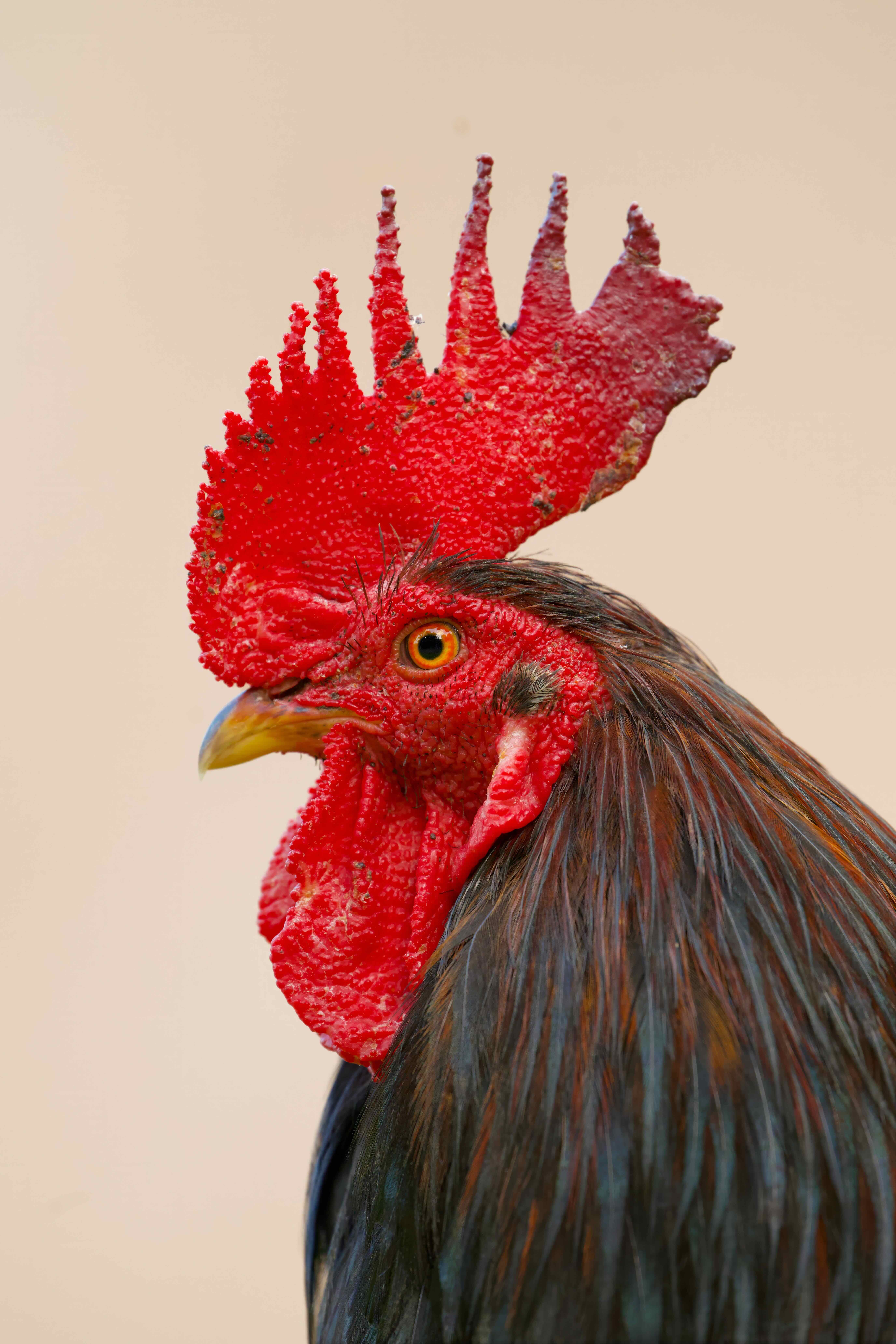
A: To eat the tarantulas.
During my recent visit to Trinidad and Tobago, a local birding guide explained that one of the reasons people commonly keep free-range chickens in their yards is to eat the tarantulas. This gave me a new respect for these domestic fowl, as I witnessed venomous tarantulas larger than my XXL-size hands, such as this female Trinidad chevron tarantula (Psalmopoeus cambridgei):

Trinidad harbors a diversity of arachnids that rivals anywhere in the Neotropics. On my night walks with my new macro lens I observed spiders (order Araneae) and harvestmen, also known as daddy long legs (order Opiliones). Both arachnids are eight-legged members of the class Arachnida, but they belong to entirely separate orders and are not closely related within that class.
Returning to the Trinidad Chevron tarantula: it constructs silken tube retreats in tree crevices, behind bark, and among epiphytic plants. It also readily adapts to human structures (e.g., tin roofs, metal pipes, and abandoned buildings) making it something of a synanthrope:

Females are large and fast-growing, reaching 18 cm (7 inches) in leg span, with striking chevron-shaped dark markings on the abdomen and green-brown coloration accented by red or orange flashes on the legs. Males are smaller, with a more uniform grey-brown appearance, and can mature in as little as one year. The species is notable for its broad diet: bats, frogs, lizards, grasshoppers, mice, and other insects have all been documented as prey.
Pharmacologically, the Trinidad chevron tarantula is of medical interest. Its venom is the source of psalmotoxin and vanillotoxin – inhibitor cystine knot (ICK) peptides that may have therapeutic applications in stroke treatment.
The pinktoe tarantula (Avicularia avicularia), is the most commonly encountered tarantula in Trinidad and Tobago. This arboreal species is named for the distinctive pink coloration on the tips of its legs in adults:
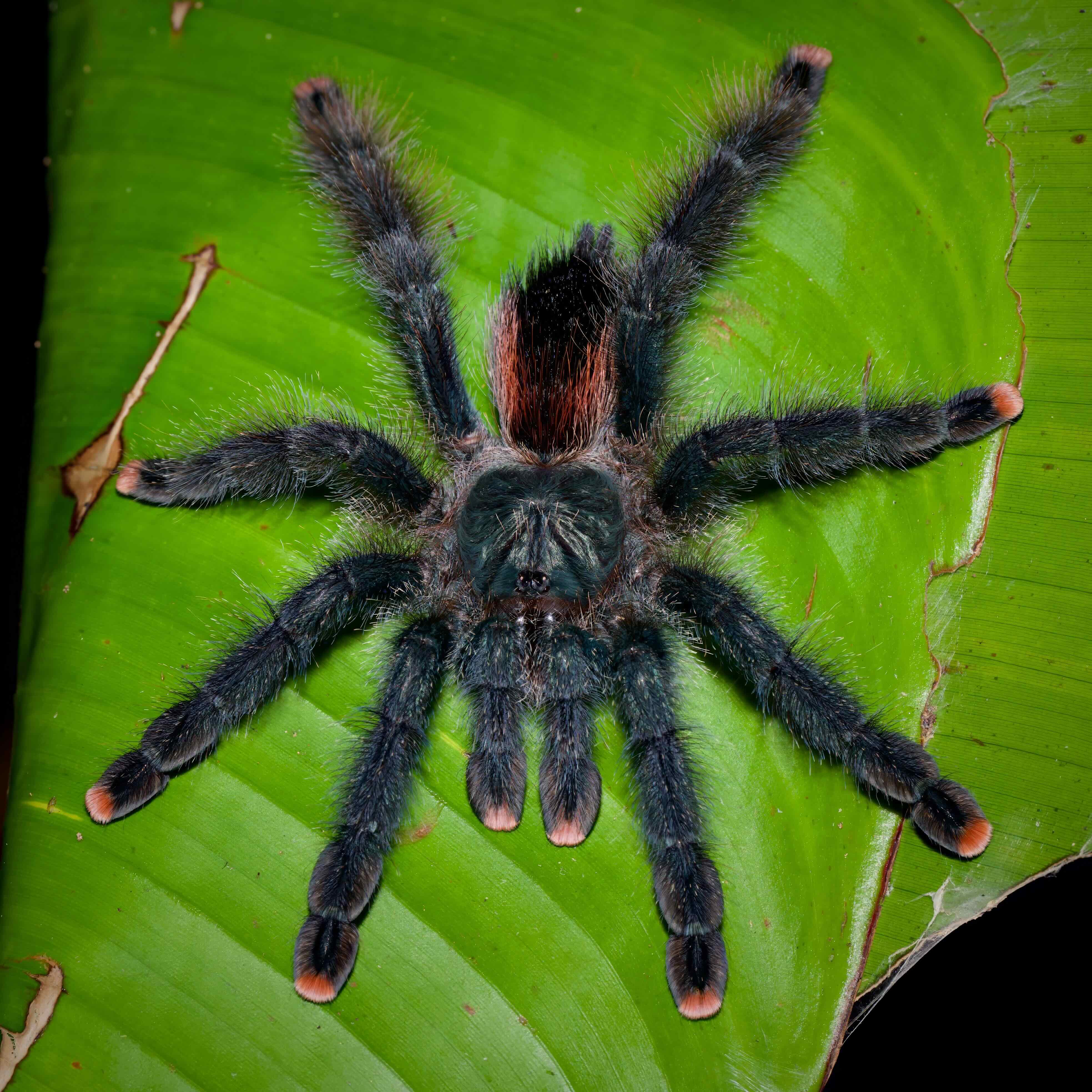
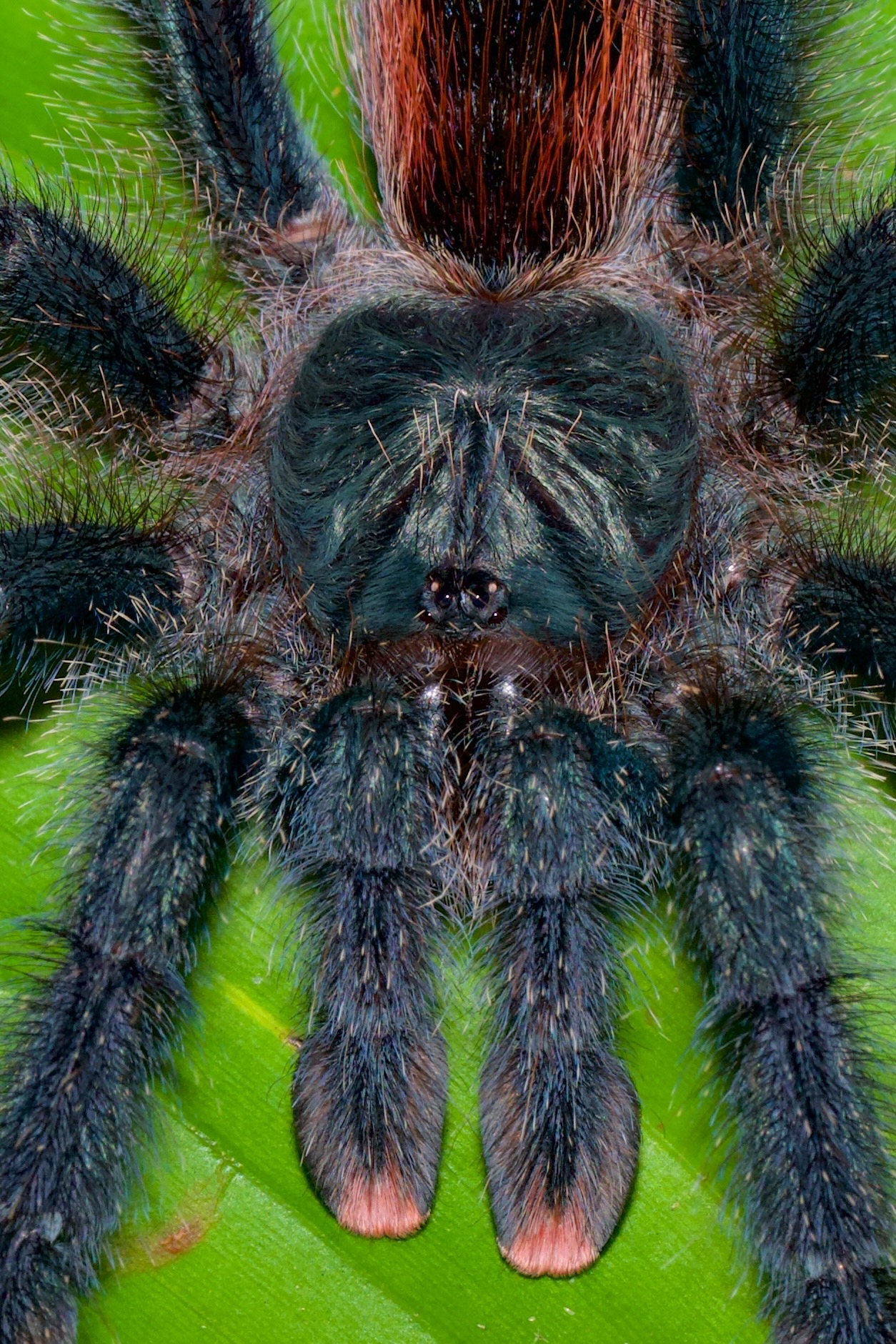
Adults reach about six inches in leg span. They are ambush predators that construct silken retreats and trip lines in tree canopies, using webbing as both trap and sensor. Unlike most tarantulas, pinktoes can jump short distances (3-4 cm), and their defensive repertoire includes propelling feces at threats, a behavior that, while unglamorous, is effective. Their venom is mild, even by New World tarantula standards. Here’s a closeup from the previous photo focused on the body:
The Giant Fishing Spider (Ancylometes bogotensis) is a semi-aquatic giant. Females reach roughly 26 mm in body length with an impressive leg span, while males are somewhat smaller at about 21 mm. These spiders walk on water using air-trapping hydrophobic hairs on their leg tips, much like water striders. When disturbed, they can dive below the surface and remain submerged for over 20 minutes by breathing air trapped in the hairs surrounding their book lungs. Their diet ranges from aquatic insects to small fish, frogs, lizards, and geckos:

Ancylometes bogotensis is sometimes confused with the infamous Brazilian wandering spider (genus Phoneutria, photo below): both are large, ground-active, nocturnal hunters with similar body plans. The name Phoneutria translates from Greek as “murderer,” and the genus has appeared in the Guinness World Records as containing the world’s most venomous spider. There are eight described species, found primarily in tropical South America with one extending into Central America.
Phoneutria species are best known for their potent neurotoxic venom, their characteristic threat display (raising the first two pairs of legs high to reveal banded leg patterns) and their wandering, non-web-building habits. They famously hide in banana bunches, boots, clothing, and dark shelters, which brings them into frequent contact with humans. Their venom contains a cocktail of neurotoxins, but fatalities are rare with modern medical treatment.
Though Ancylometes and Phoneutria were both historically placed in the family Ctenidae, Ancylometes was transferred to its own family (Ancylometidae) in 2025, reflecting the growing understanding that these semi-aquatic fishing spiders represent a distinct evolutionary lineage:

We now turn to a species of orb-weaver. The golden silk spider (Trichonephila clavipes) is one of the most conspicuous spiders in the Caribbean and Neotropical forests. Sexual dimorphism in this species is extreme: males are tiny (5-9 mm body length) and weigh roughly one-thousandth what a female does. Here is a female:

The silk itself is remarkable. It has a golden hue visible to the naked eye and is the strongest natural fiber known. Researchers have fully annotated the T. clavipes genome, identifying 28 unique silk protein genes. These spiders produce and utilize seven different types of silk. Their large, asymmetric orb webs can exceed a meter in diameter, and in the South Pacific, relatives of Trichonephila spin webs strong enough to be used as fishing nets by indigenous communities:

Project Hail Mary is a spiritual sibling to The Martian - and it's fab
What is a galaxy? That's a surprisingly difficult question to answer
Mathematics is undergoing the biggest change in its history
Scientists Find the First Direct Evidence of Binary Asteroids Sharing Material
Scientists occasionally have a hard time figuring out whether data they are seeing is an actual physical phenomenon or just a trick of their instrumentation. A new paper in The Planetary Science Journal from Jessica Sunshine and their colleagues at the University of Maryland describes one such confusing scenario. In this case, the researchers noted some fan-like patterns across the surface of Dimorphos, the asteroid hit by NASA’s DART mission, and thought it might be a trick of their camera. But after some image correction, computation, and physical experimentation, they determined the patterns were caused by the first-ever documented cases of material transfer between two asteroids.
Human populations evolved in similar ways after we began farming
Scientists may have discovered a brand-new mineral on Mars
Cosmic voids look empty but they may be tearing the universe apart
Cosmic voids look empty but they may be tearing the universe apart
Skeptoid #1031: Unearthing Ancient Advanced Civilizations
An exploration of the validity of the Silurian hypothesis, which posits the existence of a pre-human intelligent race on Earth.
Learn about your ad choices: dovetail.prx.org/ad-choices“Vinay Prasad Loves President Trump”. That, Plus 12 Other Thoughts on the End of Dr. Vinay Prasad’s Sabbatical From UCSF
The bottom line is this: when given the opportunity to prove his real-world prowess, Dr. Vinay Prasad failed.
The post “Vinay Prasad Loves President Trump”. That, Plus 12 Other Thoughts on the End of Dr. Vinay Prasad’s Sabbatical From UCSF first appeared on Science-Based Medicine.NASA’s DART asteroid smash shows we could deflect a future threat
Scientists create slippery nanopores that supercharge blue energy
Why is black rain falling on Iran and how dangerous is it?
We’ve only just confirmed that Homo habilis really existed
Pages
