
You are here
News Feeds
Generic GLP-1s are coming, but Americans don’t want to wait
Compounding pharmacies are illegally selling GLP-1 drugs, and the FDA is determined to shut that pathway down.
The post Generic GLP-1s are coming, but Americans don’t want to wait first appeared on Science-Based Medicine.Chickpeas could become the first food grown on the Moon
Undisclosed ads on TikTok skirt ban on profiling minors
Astronomers think they just witnessed two planets colliding
Strange chirping supernova confirms long-debated magnetar theory
New Study Says There's a Way to Make Dyson Bubbles and Stellar Engines Stable
While megastructures are clearly speculative, new research shows that they can (in theory) be built in a way that ensures long-term stability. These findings can provide insight into the properties of potential technosignatures in search for extraterrestrial intelligence studies.
Finding Gold In A Stellar Explosion
NASA telescopes have detected what could be the most distant gamma-ray burst ever detected. A merging pair of neutron stars generated when they merged and exploded as a kilonova. It happened in an unusual location: a tidal stream of debris created by a group of merging galaxies.
A miniature magnet rivals behemoths in strength for the first time
King penguins are thriving in a warmer climate, but it may not last
Maggie Aderin's dream: To walk by the footprints of Neil Armstrong
A glimpse into the rare earth riches of Greenland
Why are we so obsessed with protein? A new book looks for answers
New Scientist recommends sci-fi novel Under the Eye of the Big Bird
Why Are Interstellar Comets So Weird? Part 2: Why Comets Are Like Cats
Once you start listing the properties of 3I/ATLAS, it becomes clear pretty quickly that this thing is distinctly different from any other comet we've ever seen. Here's just a small taste.
Why a Peruvian mountain is becoming an 'impossible' particle detector
Graduate-student union strike looming at Harvard
It must be strike season at American universities. Spring seems to be the time when well-paid, privileged, and entitled graduate students look to their unions—unions like the United Auto Workers—to demand even higher wages, other privileges, and, as I posted yesterday, political statements by some universities.
As I reported yesterday, there’s an impending graduate-student strike at Columbia, with the union demanding not only big salary increases for the students, but also that the University do all manner of anti-Israel things, like divesting from Israel and withdrawing from opening a program in Tel Aviv. That seems to me a violation of institutional neutrality, and I trust that Columbia won’t en
Now Harvard is follow suit, threatening a strike about wages, though fortunately there are no demands there about Israel. (It’s unlikely that any union demands related to Israel would be accepted by either university, as they’ve both been subject to lawsuits for ongoing antisemitism.)
As the article in the Harvard Crimson reports, both teaching fellow and research assistants (two ways that grad students can get paid while getting advanced degrees) want raises, with teaching fellows demanding a huge increase in pay.
Harvard is not biting, so a strike may be impending.
Click the link to read the Crimson article:
This is a bit complex; see what you make of it. First, the demands (Crimson quotes indented):
Harvard rejected graduate student workers’ demands for sweeping wage increases at a Tuesday bargaining session, countering with more modest raises and declining to equalize pay between teaching fellows and research assistants.
The proposals come as contract negotiations between Harvard and Harvard Graduate Student Union-United Auto Workers stretch past a year and union members vote in an ongoing strike authorization vote launched last Tuesday.
Last month, HGSU-UAW proposed a plan to close the wage gap between teaching fellows and research assistants, which would raise TF pay by roughly 74 percent — bringing it in line with the equivalent of a 10-month RA salary. The proposal also included a 12 percent increase to base salaries and annual raises of five percent.
Harvard instead offered a 10 percent raise over four years and a nearly 3 percent raise in the first year, amounting to annual raises of roughly 2.5 percent, according to a Harvard spokesperson.
It declined to match TF and RA monthly pay, according to HGSU-UAW president Sara V. Speller.
It appears, though that TF and RA pay is the same for the first four years of graduate fellowships:
Under Harvard’s current pay structure, graduate students earn roughly $50,000 annually during the first four years of their program, typically comprising two years of fellowship funding and two years of teaching fellowships supplemented with salary top ups and summer funding.
But those supplements expire after four semesters and summer funding ends after four years. During the remainder of their time at Harvard, many graduate students rely solely on teaching fellowships — which pay roughly $6,500 per section.
Now $50,000 is certainly enough to live, even in Cambridge, Massachusetts. Notice that this is appears to be a minimum salary, as there is summary salary and diverse “top ups”. After four years, you can either teach or be an RA, and that seems to be when the differential kicks in. I know that in the biological sciences there’s no substantial disparity even after four years, as they somehow find money to adequately support all students, but perhaps it’s in the humanities where they are demanding salary increases. And I’m unable to find out much about the humanities given the time constraints of time for writing posts.
Given that no student has to pay tuition, and the salary is what the university gives them on top of tuition remission, I was told that in biology the students are sitting pretty throughout their entire graduate career, even if they have to teach after four years. They are not making $6500 per year. In fact, they’re getting paid well on top of a free education at Harvard, so one may argue that these kinds of union demands are excessive. One of those who feel that way is reader Bat, who who called my attention to the Crimson article and commented,
Much like scholarship uni athletics and the obscenities of NIL pay [universities now paying student athletes] and free agency portals for colleges, I just think none of this [graduate-student unions] has a place in higher education.
Throw the rascals out. Plenty of hungry and bright applicants in the sea (as you informed Harvard when turning them down for grad school years ago if I recall correctly).
Sometimes we geezers are right. You kids get off my lawn!
Looking for Supermassive Black Hole Binaries with a Flash of Starlight
Supermassive black hole binaries can be difficult to detect in many galaxies, but a new approach could find them by looking for the regular flashes of starlight caused by the gravitational lensing of these black holes.
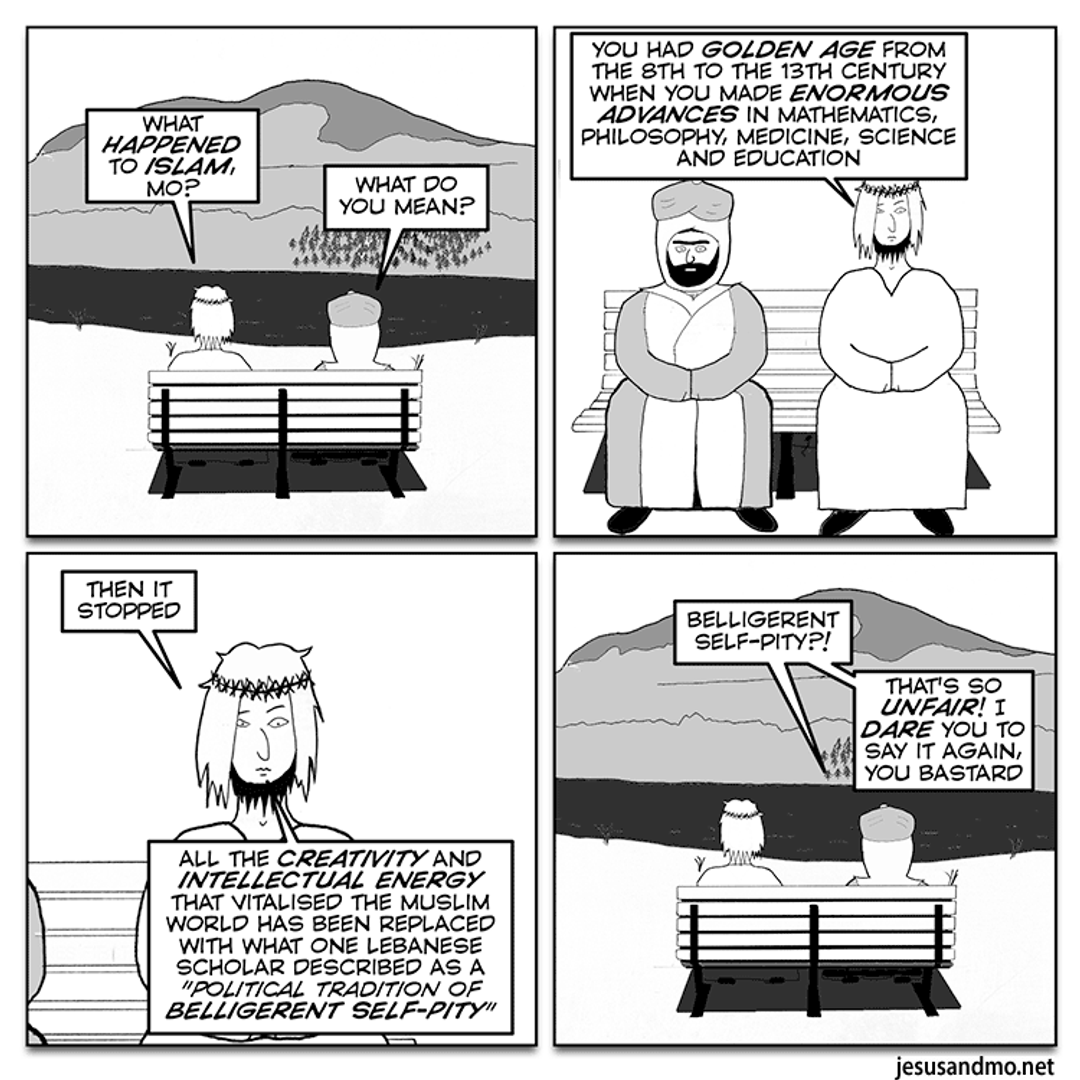
Jesus ‘n’ Mo ‘n’ self-pity
Today’s Jesus and Mo strip, called “self-pity,” came with an emailed explanation (below).
Fouad Ajami is the chap.
I’m not sure that Ajami used the phrase “belligerent self-pity”, but he was a scholar at Stanford’s Hoover Institution and a big fan of the Iraq War.
Why the world's militaries are scrambling to create their own Starlink
An Unimpressive Reiki Study
I often get e-mail suggesting topics to cover on SBM or elsewhere in my social media content. I like getting these e-mails when they are organic, coming from readers here with genuine questions about some questionable claim or practice. But often they are press contacts, by a professional promoter pushing a new study or shopping around an author or someone they represent. […]
The post An Unimpressive Reiki Study first appeared on Science-Based Medicine.Pages
