
You are here
News Feeds
JWST Sees Smoking Gun for Black Hole Mergers in the Virgo Cluster
A pair of dwarf galaxies in the giant Virgo Cluster show what can happen when these stellar cities interact. Scientists at the University of Michigan focused the James Webb Space Telescope (JWST) onto the galaxies NGC 4486B and UCD736 and found each of them sporting "overmassive" black holes at or near their hearts. Those supermassive black holes comprise a large fraction of each galaxy's mass.
A Secular Case for the Miraculous
I am a firm believer in miracles—a confession that will be immediately off-putting to readers of Skeptic. Below I will offer a definition of miracles and attempt to justify belief in them, but for the moment I will focus on a fundamental distinction between two modes of causality. I call these because-of causal mode and so-that causal mode. We can think of these as two ways of explaining an event.
Because-of causal mode example: a man walks into a bank and we ask for an explanation. One explanation tells us about the neurons firing in the motor cortex of the brain that excited a cascade of additional neuron firings, and then muscle flexing. And, of course, there was the mass of the body, the friction of shoes against the sidewalk, the heft and leverage of the doorway, and so on. This mechanical explanation makes the event intelligible; it tells us how the event took place. It took place because of all these enabling factors.
So-that causal mode example: There’s another way of making the event intelligible, and that is to explain the purpose of the man’s actions—he went into the bank so-that he could deposit some money. This is a teleological explanation.
The scientific because of explanation is concerned with immediate past events—facts about what things happened and theories about how they happened. Meanwhile, teleological explanations focus on future outcomes involving values. A teleological explanation tells us that an agent is acting for the sake of bringing about an intended state of affairs—causality guided by purpose. All living systems act with purpose; they seek beneficial outcomes; their behaviors are goal-directed, functional. They are about something.
Here we have two modes of causal explanation—both claiming to render events intelligible, but in different ways. There has been a long tradition of attempts to conciliate these two modes of causality, a tradition that I will now grossly oversimplify. Some people say that the so-that mode of causality is a mere illusion, or at best, a convenient pretense. They believe there is only one kind of causality, and that all genuine explanations can be reduced to the logic of because-of causality.
Others believe that teleological explanations are real, insisting that the universe has some sort of inherent or endowed purpose—it has a point, it is about something, for something. The entire universe behaves in the ways it does so-that an ultimate purpose in creation might be achieved. In one approach because-of causality is ultimately real and so-thatcausality is a fantasy. In the other approach so-that causality is ultimately real and the because-of causality of science is merely an instrument for working out an ultimate cosmic purpose.
The cosmic bus isn’t going anywhere that matters. It has no driver and no destination.Here’s the big question prompted by our encounter with contemporary science: is the grand epic of cosmic evolution in some way driven or guided so-that some destiny might be achieved, or is the cosmos, despite its awesome splendors, ultimately void of genuine meaning or purpose? As Steven Weinberg famously said, “the more we know about the universe the more it appears to be pointless.” There are difficulties with each of these views. If you claim there is genuine meaning somehow inherent in the cosmos, then you must tell us what it is and why we should accept it. But if the claim is that teleological dynamics are not genuinely real, then you are left with the problem of convincing us that meanings (e.g., values, expectations, the force of will) fail to have genuinely real consequences.
I wish to offer a third option, one that avoids both problems. This view says that all the elements of so-that causality (goal-directed behavior) are genuinely real phenomena, but they are recent and unintended emergents of because-of dynamics.
We might frame this emergence view in terms of two different perspectives on the nature of matter: the grunge theory and the glitz theory of matter. The grunge theory says that matter isn’t much—it’s just some sort of vague or chaotic and uninteresting stuff that becomes interesting only when the laws of nature or the will of God whip it into shape. So the grunge theory appears to assign matter to one domain, while relegating both natural law and divine purpose to another.
I want to reject the dualism of this view in favor of what I’m calling the glitz theory of matter, which holds that there are no independently real laws of nature. What we have are simply the properties of matter. A law of nature is just something we formulate as we observe regularities in the properties of matter. If we take this view then we can see that matter is not boring grunge, but wonderfully interesting and creative stuff. What makes it interesting: when certain properties of matter interact with other properties of matter, we find increasing probabilities that novel and unanticipated properties of matter will emerge spontaneously.
Here’s a simple illustration: Oxygen and hydrogen atoms have distinctive properties, and when they interact they can produce water molecules, which present new properties not found in either oxygen or hydrogen. And then the interaction of water properties with other properties of matter will increase the probability of even more novel properties. And, as proposed above, the emergence of new properties of matter may result in the formulation of completely new laws of nature. All of this follows the straight-forward logic of because-of causality. As interactions continue the probability of getting large molecules will increase, and when you have interactions between large molecules, then the probability of emergent living systems will increase dramatically. And as living creatures arrive on the scene, so too does the visionary logic of so-that causality. In a fundamental sense, the story of creation is a story about shifting probabilities and how these result in the various entities, events, properties and relations that make up the natural world.
I want to suggest that the goal-directed causal dynamics of teleology amounts to an emergent property of living systems. Before the appearance of living systems causality was limited to because-of dynamics, but with life comes purpose and value. Now agency enters the picture and things begin to matter. Living systems behave in certain ways so-that they will survive and reproduce. Molecules don’t do this. Molecules are created and constrained entirely by the care-less dynamics of because-of causality. But when molecules get really complex and interactive then it becomes more and more probable that they will gang up and behave according to a completely new mode of causality. This does not mean that because-ofcausality becomes overruled or deactivated. It means only that the because-of dynamics have called into play additional sets of anticipatory, goal-directed algorithms.
A meaningless universe has inadvertently, accidentally and aimlessly created the conditions for meaningfulness.Purposeful behavior and meaningfulness are real phenomena, not illusory; but they are also recent (~4 billion years ago) and localized (on Earth, at least). This suggests that the cosmos itself is essentially absurd—it has no meaning; it is not guided or coaxed by any agent or purpose. It is not about anything. However, without question, there are pockets of genuine meaning and purpose within the cosmos, as we are here to attest. The cosmic bus isn’t going anywhere that matters. It has no driver and no destination. But there are living beings on the bus, and they hustle here and there with all kinds of determination. My life, your life, all our lives, can be rich and full of meaning without having to claim they have cosmic significance. Life can be worth living even if we are not the point of some cosmic drama. The thing that impresses me most about the cosmic drama is that a meaningless universe has inadvertently, accidentally and aimlessly created the conditions for meaningfulness. This mysterious and wonderfully ironic accident—dare I say, “miracle”?—takes my breath away.
By “miracle” I do not mean an impossible event occurring at the behest of an all-powerful supernatural agent. I mean only this: any event, the occurrence of which is considered to be so radically improbable as to be virtually impossible. (I am excluding logically impossible events from discussion because they have a probability of zero—even gods cannot square circles). A miracle is an event having a probability value so close to zero that you cannot imagine any conditions under which it might occur. Given these terms, it might be said with good reason that many miracles have occurred in our universe—it’s just that they never occur before their time.
A thought experiment might help to clarify this. Suppose we place ourselves backward in time to some point immediately after the primordial Big Bang, when the universe was nothing but a raging inferno (no quarks, no atoms, just pure radiation) and consider the prospect of a supernova. Nothing that might have been known of the natural world at the time could possibly predict or explain the formation of stars, not to mention their fusion and expulsion of atoms. The very idea of such events would be considered so improbable as to be preposterous, impossible, and contrary to nature.
Life can be worth living even if we are not the point of some cosmic drama.Or, let us go back a mere four billion years. Again, at that point we would be completely incredulous if faced with the notion that billions of tiny objects would soon be exploring about on our young planet and behaving in complex patterns that defy all that could possibly be known at the time about the natural order of things. And yet, lo and behold, living beings emerged, not because of some magic wand, and not because of necessity, but rather because a countless series of unpredictable probability-enhancing events brought forth the enabling conditions.
We have the meaning-bearing lives we do because they were made incrementally less improbable by the epic events of cosmic evolution, whereby matter was distilled out of radiant energy, segregated into galaxies, collapsed into stars, fused into atoms, swirled into planets, spliced into molecules, captured into cells, mutated into species, compromised into ecosystems, provoked into thought, and cajoled into cultures. Surely, there is nothing intellectually shameful about embracing the staggering beauty and the humbling fortuity of these events as … miraculous.
The World Welcomes the Crew of Artemis II Home!
After achieving their record-breaking 10-day flight around the Moon, the crew of the Artemis II mission returned home on Friday, April 10th, 2026.
People are refusing transfusions from donors vaccinated against covid
Monkeys walk around a virtual world using only their thoughts
What to read this week: Emma Chapman's mind-expanding Radio Universe
New Scientist recommends Jamie Bartlett's insightful How to Talk to AI
Why cloning anyone – even Jim Carrey – isn't the best plan ever
Werner Herzog searches for ghost elephants in stunning new documentary
Startling images show how fake news isn't just a 21st century issue
The biggest threat to Chernobyl is no longer radiation
Planetary Exploration With Four-Legged Rovers Carrying Only Two Instruments
European researchers tested four-legged semi-autonomous rovers that carry only two instruments. These capable and agile robots could be part of the future exploration of Mars and the Moon. Their autonomy means they can do more with fewer instructions.
Largest ever map of universe captures 47 million galaxies and quasars
Neanderthal infants were enormous compared with modern humans
Catching the 2026 April Lyrid Meteor Shower
April flowers mean one thing to springtime sky-watchers: it’s time for the Lyrid meteor shower. The Lyrids are always a good bet, and always make the top ten list for annual meteor showers. And to top it off, 2026 is a favorable year for the Lyrids, with the waxing crescent Moon mostly out of the way.
Jesus ‘n’ Mo ‘n’ a rock in a box
Today’s Jesus and Mo strip, called “rock2“, comes with a note that says this: “An oldie from 2006 today. Next week’s will also be a resurrection.” The artist must be on hols.
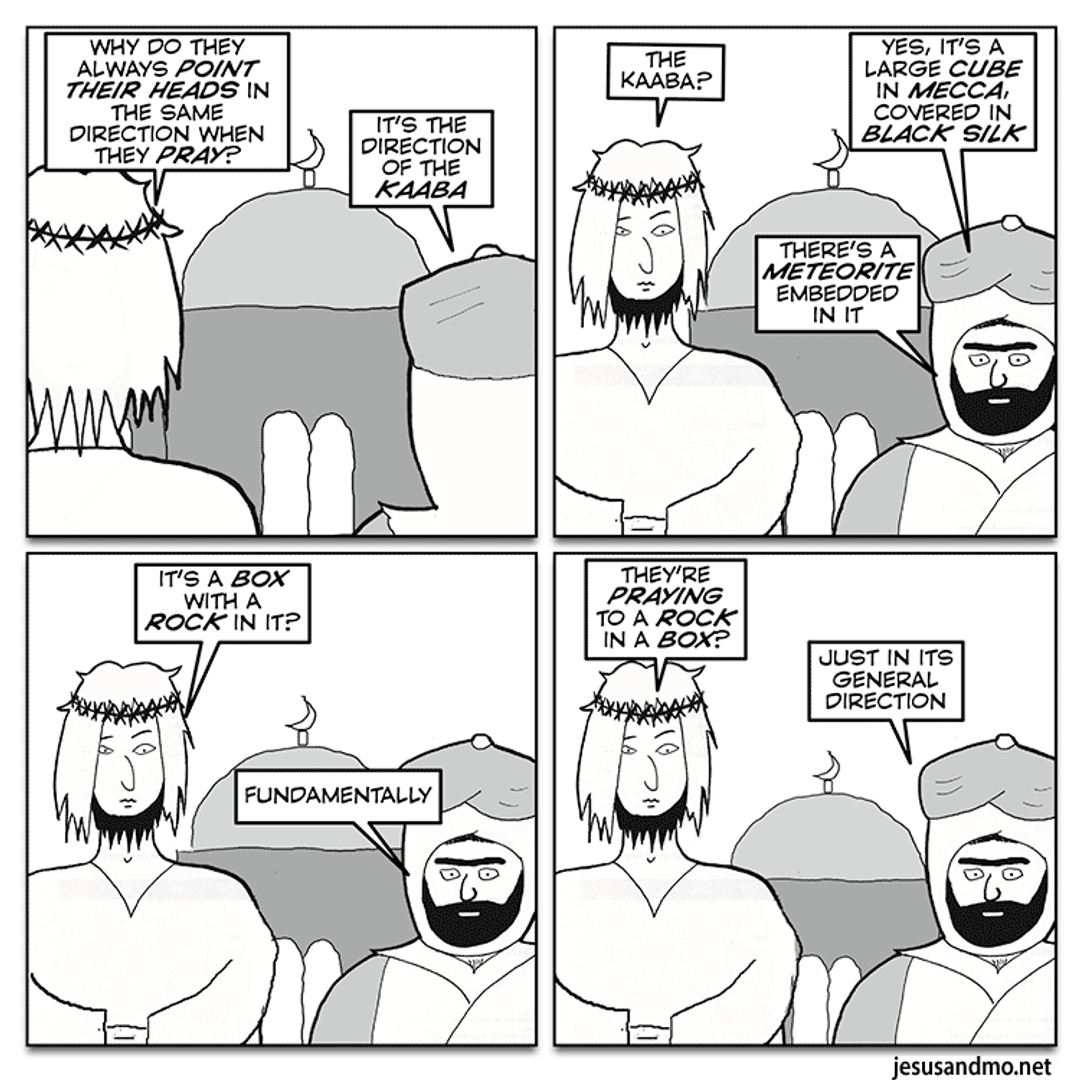
Is Mo right about the black silk and the meteorite? Well, at least half right. The Kaaba is indeed covered with a cloth made of silk, but the meteorite is questionable. Here’s what Wikipedia says, along with a picture. (The stone is called Ajar al-Aswad.)
The Black Stone (Arabic: الحجر الأسود, romanized: al-Ḥajar al-Aswad) is a rock set into the eastern corner of the Kaaba, the ancient building in the center of the Masjid al-Haram in Mecca, Saudi Arabia. It is revered by most Muslims as an Islamic relic which, according to tradition, dates back to the time of Adam and Eve.
The stone was venerated at the Kaaba in pre-Islamic Arabia. It is sometimes considered a baetyl. According to tradition, it was set intact into the Kaaba’s wall by Muhammad in 605, five years before his first revelation. Since then, it has been broken into fragments and is now encased in a silver frame on the side of the Kaaba. Its physical appearance is that of a fragmented, dark rock, polished smooth by the hands of pilgrims. It has often been described as a meteorite, but it has never been analysed with modern techniques, so its scientific origins remain the subject of speculation.
Muslim pilgrims circle the Kaaba as a part of the tawaf ritual during the Hajj and many try to stop to kiss the Black Stone, emulating the kiss that Islamic tradition records that it received from Muhammad.While the Black Stone is revered, theologians emphasize that it has no divine significance and that its importance is historical in nature.
Saudi Press Agency (SPA), CC BY-SA 4.0, via Wikimedia Commons
New Study on AI Clinical Decision-Making
Large language model artificial intelligence applications (LLM AIs) seem poised to have a significant effect on the practice of medicine, both good and bad, which is why we are giving it as much attention as we are here. LLMs give impressive results when tested on medical knowledge, able to pass multiple-choice exams designed for general medical and specialty certification. In fact it […]
The post New Study on AI Clinical Decision-Making first appeared on Science-Based Medicine.Scientists think alien life might be hiding in patterns
Stardust in the Clouds of Venus.
Venus has been hiding a secret for fifty years. Just below its main cloud deck sits a mysterious layer of haze that spacecraft first detected in the 1970s and nobody could explain where it came from. Now a research team in Japan has finally cracked it, and the answer comes from the last place most people would think to look!
Magnetism Frozen in Time.
Every star you've ever looked at is hiding a magnetic secret and it may have been hiding it since birth. A new theoretical study has connected, for the first time, the magnetic fields detected deep inside dying red giants with the magnetism found at the surfaces of their long dead remnants. These fields may be ancient fossils, born early in a star's life and surviving billions of years of violent transformation completely intact.
Pages
