
You are here
News Feeds
How an American college woman turned into a propagandist for terrorism
The Free Press has a long article on Calla Walsh, a 21 year old American woman who became radicalized at about 16 and now lives in the Middle East, making propaganda for Hezbollah and Iran.
Here’s a mugshot of Walsh from an earlier arrest in the U.S. for vandalism and trespassing on the grounds of an Israeli-owned company said to be involved with “genocide.” She served two months in prison.
Merrimack, Massachusetts Police Department, Public domain, via Wikimedia Commons
Here she is all growed up (see link below). I’ve put a recent Instagram post at the bottom.
Walsh was the definition of “privileged” when young: the scion of two academics from Cambridge, Massachusetts, and one who attended two fancy prep schools before dropping out of Canada’s McGill University after one semester. She started off advocating against climate change and writing about the Democratic Socialists of America for Teen Vogue (thank goodness that rag went belly-up!), and campaigned for the successful re-election of Senator Ed Markey, as well as other Democrats (see an admiring profile of Calla in a 2021 Boston Magazine ). She then went on to oppose the “genocide” committed by Israel in the Gaza war, visited Cuba, and after that she went full Monty—or should I say full Mamdani? She traveled to Iran and has apparently settled in Beirut.
The Free Press details what happened to her and where she is now. Click below to read; the article cannot be archived. If you want a shorter account, read her Wikipedia bio, which includes the following:
Walsh’s political ideology has shifted over time. In the 2010s, she was a member and activist in the Democratic Party, as well as an environmental activist. In 2021, NPR described her as a “progressive organizer and activist based in Massachusetts”. Later in 2021, she identified as a Democratic Socialist and a member of the Democratic Socialists of America. In 2023, she described herself as a communist and anti-imperialist.
Following the October 7 attacks, Walsh tweeted that “defending their homeland from illegal occupation and genocide isn’t ‘ugly Palestinian retaliation'”. Later that day, Walsh posted a map of the attack sites with the message, “This is what decolonization looks like”. In April, Walsh added, “We will never forget who called Palestinian freedom fighters ‘terrorists’ after October 7 and then turned around and claimed to support Palestine”. On October 12, Walsh tweeted that those living in the US have “an obligation to take direct action against murderous companies like Elbit”.
For the 2024 presidential election in the United States, Walsh filled in the name of Yahya Sinwar as a write-in candidate. Walsh has expressed support for Tyler Robinson, Elias Rodriguez, and Mohamed Sabry Soliman.
In December 2025, Walsh was nominated by the pro-Israel group StopAntisemitism for “Antisemite of the Year”.
In February and March 2026, following the 2026 Iran conflict, Walsh wrote a series of posts on X social network calling for the use of global violence against Israeli and American officials. Following the start of the 2026 Iran massacres, Walsh was one of several media personalities that promoted the Iranian state’s claim that the protests had been stoked by the CIA and Mossad.
She’s clearly a hater of both Jews and America, and given what she’s done, she’ll never be allowed back in the U.S., or, if she is, she’ll have to spend a long time behind bars.
A couple of long excerpts of a very long article:
In the weeks since the U.S. and Israel launched their joint assault on Iran, perhaps no American has more aggressively and publicly rallied behind the Islamic Republic than Calla Walsh. From her new base in Lebanon, the 21-year-old Cambridge-raised activist has taken to social media and left-wing podcasts to incite her fellow countrymen and women to sabotage U.S. and Israeli defense contractors wherever they can find them. On March 3, she mocked four American soldiers killed in an Iranian drone strike, posting: “They all died fighting for fascism, genocide, pedophilia, and cannibalism.” She attached pictures of the dead Americans. In recent days she reposted a list of missile-production sites inside the U.S.
“We have a duty to escalate,” Walsh told her host on the Psychic Militancy podcast last Saturday from Beirut, noting that “lockdowns” of weapons factories and vandalism alone are “not sufficient at this point.”
She added: “And as the genocide and these wars of aggression continue to escalate, much more is demanded of people in the West.”
Walsh looks every part the art-school hipster, with her thick-rimmed glasses and a mop of curly hair. But she’s a chameleon of terror. Five years earlier, as a 16-year-old, Walsh was fawned over by The New York Times for being a young, social media-savvy activist who was helping to shake up the Democratic Party in Massachusetts. But as a monthslong investigation by The Free Press shows, she’s thrown her allegiance squarely behind the Islamic Republic of Iran and its Axis of Resistance, which includes the Palestinian terrorist group Hamas and Lebanon’s Hezbollah. The U.S. government has placed her on a suspicious persons watch list for her expansive dealings with the governments of Cuba and Iran, U.S. officials told me, as well as a spiderweb of U.S.-designated terrorist groups.
Over the past few years, Walsh’s radicalization has played out in real time on X and Instagram. She quickly moved from political organizing for the Democrats to the Democratic Socialists of America (DSA) to conducting guerrilla-style raids on Israeli defense companies in New England, for which she received jail time in 2024. She has regularly called for the assassinations of Israeli officials and their allies in the U.S. and elsewhere.
In October, she formally relocated to Beirut, The Free Press learned, where she has established herself as a regular contributor to Iranian state media, particularly the English-language site of Tehran’s Press TV on which Washington has imposed sanctions. She is actively engaging in propaganda and information-warfare operations on behalf of the Iranian regime and Hezbollah, which is fighting Israeli forces in south Lebanon.
She’s too far gone, I think, to ever return to the U.S., and perhaps she doesn’t want to. But those who ally themselves with American enemies in this way are rarely either allowed back to where they were born or, when do they are jailed. I suspect that Walsh will be in Lebanon for good. A bit more:
According to U.S. counterterrorism officials I spoke with, any financial or operational ties Walsh has established with blacklisted organizations—whether in Iran, Cuba, or Lebanon—means she could be indicted for providing material support to proscribed groups. Walsh’s latest trip to Tehran places her in even greater legal jeopardy if she ever returns home.
“I’ve never seen someone who’s done jail time so publicly integrate herself into terrorist infrastructure,” a senior national security official told me. “She’s totally exposed now.”
More:
. . . . Walsh’s new role as Tehran’s Gen Z propagandist has her regularly appearing on Iranian state media with other outcasts from Europe and North America. In December, Walsh was a guest on a Press TV show called Palestine Declassified, with two Britons who have been banished from UK politics and academia in recent years for antisemitism. She set up a camera from her Beirut apartment to tape the show and extol the military prowess of the late Iranian general, Qasem Soleimani, whom the U.S. assassinated in a 2020 drone strike.
And this, near the end, show how ideologically captured she is, so much so that she blames Mossad for massacring Iranian civilians:
In February, when Walsh returned to Iran, she provided an American face to spread the message that it was the CIA and the Israeli spy service, Mossad—not the Iranian government—that massacred thousands of Iranians during the prior month’s uprising. (The United Nation’s special rapporteur on Iran estimated the number could be over 20,000.) “The fact of the matter is police in Iran are defending the revolution and are defending their government from U.S. and Zionist-backed regime change,” she said on Press TV.
. . Experts in extremism tell me they’re deeply worried that the American is now too far gone. In recent weeks, she’s crisscrossed the Middle East in support of the Axis of Resistance, placing her in the range of American and Israeli bombs and fighter jets, whether in Tehran or south Lebanon.
“She’s a true believer. It’s over after that, because you’ll do anything for your cause,” said Mubin Shaikh. He was a jihadist in Pakistan and Syria before going through a deradicalization program in Canada and emerging as one of his country’s top counterterrorism experts. “Martyrdom? Don’t think that’s off the table.”
You can imagine how dicombobulated her parents are. They are quoted as saying, “We love Calla deeply and absolutely. . . . And we have serious, fundamental political disagreements with her.”
Here’s a recent Instagram post. Click screenshot to see a video interview from presstvchannel, an Iranian-controlled state media site. Note that she uses “anti-Zionist” instead of “antisemitic”. This euphemistic ploy disgusts me.
We have wood ducks!
Botany Pond now harbors (temporarily, I think) a pair of the most beautiful American ducks: wood ducks (Aix sponsa), in the same genus as mallards. At first I mistook them for mallards on the duckcam, but when I went down to investigate, it was clear that they were a bonded pair of woodies.
I love these ducks, but one or two show up at Botany Pond only every couple of years, and they do not breed here. We had a post-breeding pair, Frisky and Ruth, a few years ago, but although they hung around a while, it was after they had bred, and they were probably headed south. My photos from that era have disappeared from this site, but here is Frisky nuzzling Ruth. It’s one of my favorite duck photos (I like to imagine that wood ducks are very romantic!):

Frisky was so named because although the mallards chased him, he was very quick and adept at sneaking among them at feeding time to get pellets. After he filled his belly, he’d get quite rotund and then perch on a knob of the bald cypress that used to be in the pond. He used that knob so often we called it The Sacred Knob. Here he is having a postprandial rest. Look at those colors!

Males have satanic red eyes. Here’s a closeup of Frisky’s head. Their bills are short compared to those of mallards.

They’re called “wood ducks” because they nest in treeholes and perch on trees—nearly the only species of duck to do so. Sure enough, when I first saw them a few days ago, they were both up in trees next to the pond. I thought they left, but, sure enough, they were back three days ago and haven’t left since.
Some photos of our new pair. Feel free to suggest names, but they should be fitting for these glorious birds.
The new male:


. . . and the new female. The shots aren’t great as I took them in the early morning when it was light, and the shutter speed was slow:

Wikipedia describes them like this:
The adult male has stunning multicolored iridescent plumage and red eyes, with a distinctive white flare down the neck. The female, less colorful, has a white eye-ring and a whitish throat. Both adults have crested heads. The speculum is iridescent blue-green with a white border on the trailing edge.
Besotted with each other, the ducks are always together. Here are two videos of our new pair swimming together:
In this next video, the male gives her a little kiss 6 seconds in. He then chirps at her (they don’t quack).
The loving couple. Look at that sexual dimorphism! These ducks are in full breeding plumage:

Vashti is nesting nearby, and Armon is always in the pond waiting for her to drop in for a quick snack, a drink, and a preen before she hurries back to her nest. There are seven lovely green eggs in Vashti’s nest, and I anticipate ducklings will hatch around April 20 (a bit early in the season) if all goes well.
Armon chases the woodies, but only in a desultory manner, and they manage to sneak some of the food I give him. At other times he allows them to rest next to him on the rocks.
Here’s Armon halfheartedly chasing the female. He never gets near either of them as they swim faster than he, and they can simply jump out of the pond when they’re tired of being chased.
Ducks on the rocks (a good name for a drink). You can see that Armon doesn’t mind them being nearby so long as it’s not feeding time. The size difference between mallards and woodies is clear:


The male is like a feathered jewel! Here is the range of Aix sponsa from Wikipedia. As you see, Chicago is in their year-round range.
Cephas, CC BY-SA 4.0, via Wikimedia Commons

You might be able to see them on the DuckCam if you look now, but keep looking from time to time. In the meantime, feel free to suggest woody names, and get ready for mallard ducklings in a few weeks.
I think the woodies will soon depart to breed in a place where there are trees with holes.
I’ll add a Smithsonian video of a large clutch of hatched woodies jumping about 50 feet down to the water as mother calls them:
This hidden state of water could explain why life exists
Readers’ wildlife photos
Abby Thompson of UC Davis has sent in some pictures of California tidepool organisms, as well as a video. Abby’s captions are indented and you can enlarge her photos by clicking on them.
Late January-early March tidepools, plus an octopus.
Bryozoans:

Lepas anatifera (pelagic gooseneck barnacle). Usually found clinging to something drifting around in the open ocean (the “pelagic” part of their name), these were on a large log washed up on shore:

Intertidal zones, illustrated. A well-placed vertical rock face, like this one, exhibits the idea of the different intertidal “zones”, each of which has its own specific collection of inhabitants. You can see mussels and barnacles clustered at the top (in the “high intertidal”), exposed to the air as soon as the tide goes out even a little. There are smaller colonial anemones next, beneath them the orange and purple ochre stars, and below those, arriving at the low intertidal level, some giant green anemones. If you peer into the water under the open giant green anemone, you’ll see a crab, probably a rock crab. There’s some back and forth- there are a few giant green anemones pretty high up in this photo- but the general idea holds.
This reflects each animal’s differing tolerance for specific conditions- time out of the water as the tide goes out, harshness of wave actions, etc. The nudibranchs (next few pictures) are usually in the very low intertidal:

Orienthella piunca (nudibranch):

Hermissenda opalescens (nudibranch):

Doto amyra (nudibranch). Visible through the translucent skin on its back are lobules of the “ovotestis” (thanks inaturalist expert! ). From google AI: “Ovotestes in nudibranchs are specialized, hermaphroditic reproductive glands that produce both male (sperm) and female (oocytes/eggs) gametes simultaneously”:

More eggs, this time from a snail in the genus Amphissa. I like the pointy egg casings, like wizards’ hats:

And here’s an adult of the genus- almost certainly Amphissa versicolor, but it’s an unusual color (they’re usually shades of orange or brown/tan):

In honor of Ghost the octopus, and also because I’ve finally figured out how to include videos, below is a clip from 2021 of an East Pacific red octopus (Octopus rubescens), cruising around the rocks (out of the water!) at low tide. I’ve only seen one twice, probably because they’re too cleverly camouflaged (possibly just too clever) for me to spot. This guy was about the size of a human hand, a miniature compared to the 50 pound Ghost.
Point Reyes peninsula at sunset:

Camera: Olympus TG-7.
This quantum computing breakthrough may not be what it seemed
Pulsars Rewrite the Rules
For decades, astronomers thought they knew that pulsars broadcast their signatight beams of radio waves fired from near the surface, close to the magnetic poles. A new study of nearly 200 of the fastest spinning pulsars in the universe has just turned that idea on its head. It turns out these extraordinary objects are broadcasting from two completely separate locations at once, and one of them lies right at the outer edge of their magnetic grip on space itself.
How the Solar Wind Really Works
The Sun doesn't just pump out light and heat, it blasts a continuous stream of charged particles across the Solar System, and that solar wind is far more complex than it looks. Hidden within it are waves that act as invisible middlemen, constantly shuffling energy between particles as the wind expands outward. Now, thanks to the European Space Agency's Solar Orbiter spacecraft, we have our clearest picture yet of how those waves behave close to the Sun itself.
World's smallest QR code, smaller than bacteria, could store data for centuries
Scientists just found a way to store massive data using light in 3 dimensions
Scientists just found a way to store massive data using light in 3 dimensions
Blocking out the Stellar Lighthouses
Finding another Earth is one of the greatest scientific challenges of our time and the biggest obstacle isn't the distance, it's the glare. An Earth like planet orbiting a Sun like star is ten billion times fainter than its host. A team of NASA engineers at the Jet Propulsion Laboratory are developing a remarkable piece of optical wizardry that could solve the problem of seeing planets hidden by the stellar glare and they're already within striking distance of the performance needed to make it work.
A Galactic Wind Caught in the Act
Twelve million light years away, a galaxy is throwing a tantrum on a cosmic scale. M82, the Cigar Galaxy is forming stars at ten times the rate of our own Milky Way, and all that frenzied activity has been blasting superheated gas outward in a colossal wind stretching 40,000 light years. Scientists have long known the wind exists, but now, for the first time, they've measured exactly how fast it's moving and the answer raises as many questions as it answers.
Bennu’s Rugged Rocks Explained by Deep Internal Cracks
Asteroids don’t get the love they deserve. They don’t get “cool points” because they’re not a planet or a potential life-harboring moon. They’re “just a bunch of rocks”. But asteroids are so much more, as they are time capsules of the early solar system that have survived billions of years untouched by weathering or plate tectonics. One of the most intriguing asteroids that has been explored is asteroid Bennu, and specifically how its physical characteristics greater differed from Earth-based observations in 2007 after NASA OSIRIS-REx spacecraft visited Bennu in 2018.
Exomoons Could Be Habitable for Billions of Years, Provided they have Hydrogen Atmospheres
Liquid water is considered essential for life. Surprisingly, however, stable conditions that are conducive to life could exist far from any sun. A research team from the Excellence Cluster ORIGINS at LMU and the Max Planck Institute for Extraterrestrial Physics (MPE) has shown that moons around free-floating planets can keep their water oceans liquid for up to 4.3 billion years by virtue of dense hydrogen atmospheres and tidal heating—that is to say, for almost as long as Earth has existed and sufficient time for complex life to develop.
Caturday felid trifecat: Library accepts cat photos in lieu of late fees; the history of Downing Street cats; lost cat reunites with family after five years; and lagniappe
Yes, I know I’ve misspelled “trifecta” in the title, but that’s deliberate. Today we have the usual three items for Caturday, plus two lagniappes.
First, a heartening story from the 100 Libraries Magazine. Click to read.
The Worcester Public Library in Massachusetts is, well, let them announce it:
Photo courtesy of the Worcester Public Library
From the text:
Embracing the spirit of the program, library patrons are encouraged to swap traditional monetary payments for a simple yet delightful alternative—a photo or drawing of a cat. Executive Director Jason Homer extends a warm invitation to all, regardless of feline companionship status.
“Even if you don’t have a cat in your life, you can still draw one,” Mr. Homer expressed to NBC Boston, highlighting the inclusive nature of the initiative. From domestic cats to majestic big cats like tigers and lions, all submissions are welcome with open arms.
Recognizing that accidents happen and fees can sometimes hinder access to library resources, the library hopes to extend a gesture of goodwill and understanding through this unique initiative.
Why March Meowness?
The inspiration behind “March Meowness” stems from a noticeable increase in overdue fines among young patrons, a trend exacerbated by the challenges posed by the pandemic. However, what started as a simple solution to address financial barriers quickly blossomed into something much more profound. Within just the first five days of its launch, the program had already cleared over 400 accounts, underscoring its immediate impact and resonance within the community.
In essence, “March Meowness” transcends the realm of library fines, serving as a testament to the power of creativity, compassion, and community spirit. Through a simple yet meaningful gesture, the Worcester Public Library not only alleviates financial burdens but also reaffirms its role as a cornerstone of the community—a place where everyone is welcome, regardless of their ability to pay. As patrons flock to share their beloved feline companions or imaginative renditions thereof, the library continues to serve as a beacon of hope, connection, and joy in uncertain times.
And here, from TikTok, is a wall o’cats showing how many people donated photos in lieu of fines (sound up):
@worcesterpublibIt was a valiant effort by our staff to try to get a many cat photos as possible up on our cat walls at several of our locations. We ran out of time and staff, but did our best! We hope you enjoyed this a much as we did! #catsoftiktok #catstagram #cats #librarytok #librarytiktok #library #worcesterma #mywpl #MarchMeowness #viral #fyp #fypシ #fypage #foryou #foryoupage #foryourpage
♬ Come Check This (Quickie Edit) – FETISH
And from the NBC Evening News, where we learn that photos have been sent to the library from all over the world. The response would not be nearly as awesome if they wanted dog pictures, because cats rule the internet.
********************
In honor of Larry the Cat‘s 15th birthday and 5 years of service as Chief Mouser to the Cabinet Office, Mark Felton Productions has put out a lovely 11-minute video detailing the history of Downing Street Cats beginning on June 3, 1929 when the government authorized the position. Rufus was the first Downing Street cat, replaced by Peter, and so on (one was also called “The Munich Mouser,” who was staffed by Neville “Peace in Our Time” Chamberlain.
It’s a great video, so watch.
Here’s a timeline of all the 10 Downing Street cats (via Wikipedia), and the parthy of the PM’s who staffed them. Click to enlarge.

********************
From the UPI’s “odd news” we have the story of a lost cat who came home after five years:
From the text:
A Maryland family whose pet cat went missing five years ago were reunited with the pet when she turned up in a stranger’s basement.
Melissa and Brooke Garci said Aremis, their indoor/outdoor cat, wandered away from home in Hickory in September 2021 and never came back.
The family canvassed the neighborhood and put up flyers, but there was no trace of Artemis.
The Harford County Humane Society said a woman came to the facility in February with a cat she found in her unfinished basement.
The shelter scanned the feline for a microchip, which identified her as Artemis.
“I was like, I couldn’t cry yet because I was in disbelief, but when I saw her, I was like, ‘OMG, she looks exactly the same,'” Brooke Garci told CBS Baltimore. “It was a beautiful thing.”
The humane society said the reunion was a reminder of the importance of having pets microchipped.
Always get your cat chipped, even if it’s an indoor cat. They can escape, you know, as Artemis did. 40% of lost cats with chips are returned to their owners. (Be sure your chip is updated if you move or change your phone number.)
Here’s a video of the grand reunion (warning, there are d*gs as well):
********************x
Lagniappe: Two cat videos from The Good News girl:
Kiki the School Cat:
Reader’s wildlife photos
Today Athayde Tonhasca Júnior is back with one of his patented text-and-photo posts, which have always been very informative. Today he talks about palms and their pollinators in one area of Brazil. Athayde’s captions are indented, and you can enlarge his photos by clicking on them.
Beneficial saboteurs
It’s approaching midday somewhere in the caatinga, northeastern Brazil’s hinterland, and the temperature will soon hit the 40o C mark. All is quiet, as most animals are sensibly sheltering from the sizzling sun. The vegetation looks dead and stunted, but it is in fact quiescent, in a state of dormancy that helps plants endure the heat and drought until the rainy season arrives.
Fig.1. The caatinga vegetation in northeastern Brazil looks dead during dry season, but palm trees are green year round:

One palm tree, however, known locally as licuri (Syagrus coronata), doesn’t seem bothered by the harsh climate; it is verdant and in full bloom. The plant is monoecious, that is, it produces separate male and female flowers in the same individual. Male flowers grow at the end of large (~90 cm long) inflorescences, while the female flowers are at the base. Anthesis (the stage at which a flower is open and functional) is asynchronous: male flowers open first, releasing pollen and scent for 7 to 10 days. These flowers then shrivel and fall off. In about two weeks, it’s the female flowers’ turn; they are open for 10 to 15 days. Plants also bloom asynchronously, so at any given time of the year there are licuri flowers.
Fig.2. Licuri inflorescences © Drumond, 2007:

These flowery details may seem like too much information, but they are important for understanding the plant’s relationship with one of its most important flower visitors, the weevil Anchylorhynchus trapezicollis.
Like the overwhelming majority of the ~83.000 known species of weevil (family Curculionidae), A. trapezicollis feeds on plant tissues. Attracted by the scent of male flowers, a beetle uses its big schnozzle (in fact its rostrum, the snout-like projection from the head) to pry flowers open and take their pollen. While feeding, the beetle ends up with pollen grains attached to its body. As male flowers open at different times, there’s isn’t much food to be consumed in one sitting. The beetle is then encouraged to move to another plant, taking with it pollen that will result in cross pollination if the insect lands on a receptive female flower.
Fig.3. An A. trapezicollis in action on a licuri flower © Bruno de Medeiros, iNaturalist.Lu:
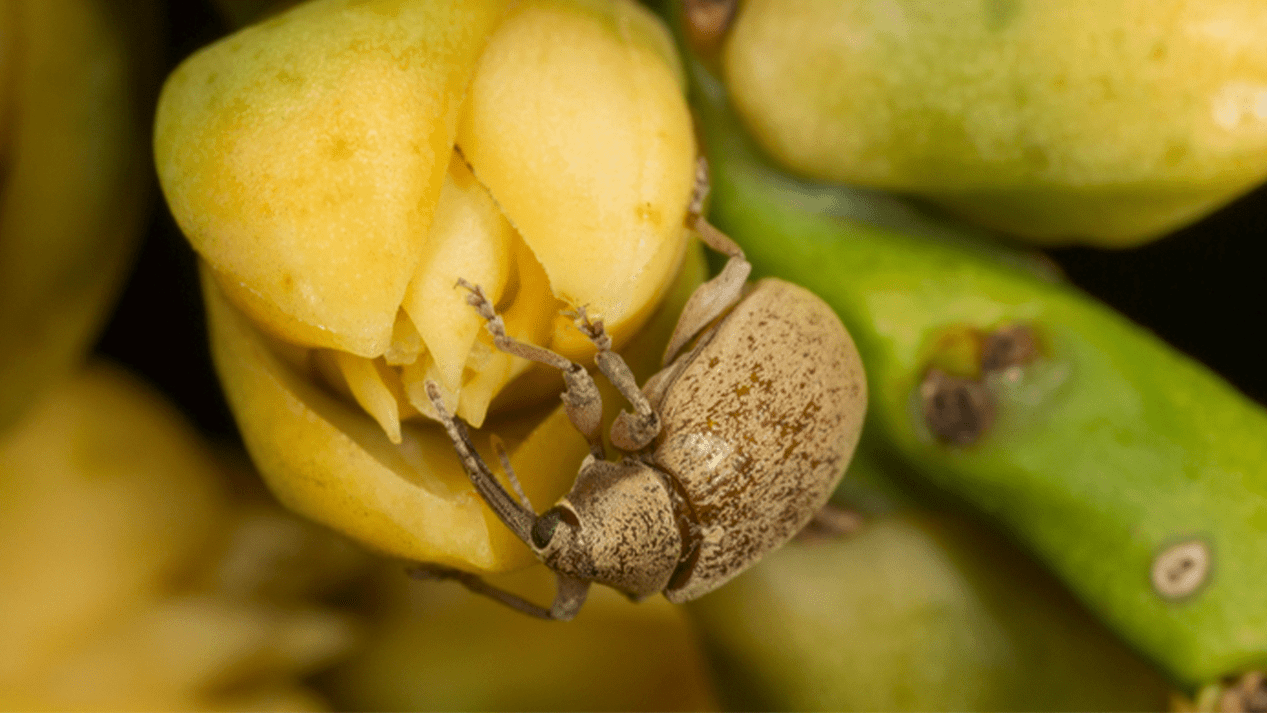
After feeding, a female beetle looks for female flowers to lay her eggs between the petals and sepals. The resulting larvae are cannibals: one larva will eat any competitor in the same flower. As they grow older, the little darlings shift their attention to developing fruits, which are aborted and fall off. Because it destroys forming fruits to complete its life cycle, A. trapezicollis is a seed predator. But for the cost of a portion of its fruits, the licuri palm is pollinated. This form of mutualism is known as brood-site pollination or nursery pollination, a trade-off association that has evolved for the yucca and the yucca moth, figs and fig wasps, and several other plant-insect partnerships.
Fig. 4. The licuri‘s trunk ends in a distinct crown of slightly arched leaves, a feature that inspired its specific epithet coronata (crowned) © Kelen P. Soares, Flora e Funga do Brasil:

Other weevils and bees also pollinate licuri, but A. trapezicollis seems to be the most important agent (Medeiros et al., 2019). This tight relationship has profound ecological consequences.
It is said that everything from a pig can be used except the oink, but licuri is not far behind in relation to its usefulness to humans. Its apical meristem (palm heart) is edible; the leaves are the source of a high quality wax, building materials, hats, baskets, sleeping mats and other handicrafts; ground-up leaves are fed to livestock in times of food scarcity; the tasty seeds (endosperm or nuts) are eaten raw or roasted, or added to confectionery and local dishes; oil extracted from seeds is used for lighting and the manufacture of soap, perfumes and other products.
Fig.5. The greenish pulp (mesocarp), brown hard shell (endocarp) and the nutritious white nut (kernel) of a licuri fruit © B. Phalan, Wikimedia Commons:


Humans are not the only creatures to benefit from licuri: many animals take the wholesome fruits. Among them, the Lear’s macaw (Anodorhynchus leari), an endemic and endangered species, for which licuri nuts represent the bulk of its nutrition.
Fig.6. Lear’s macaws, big fans of licuri nuts © João Quental, Wikimedia Commons:


There you have it: a palm tree of unordinary value, from people’s welfare and economy to endangered macaws and wildlife in general, is greatly dependent on pollination provided by unassuming weevils. And this is not an isolated case. More than 200 palm species (family Arecaceae) are pollinated by weevils, and so are many other plants from different lineages (Haran et al., 2023). The ‘million dollar weevil’ (Elaeidobius kamerunicus) illustrates well the relevance of these insects as pollinators. This beetle was introduced from Africa to Asia to help improve pollination of cultivated African oil palm (Elaeis guineensis), resulting in considerable increase in yields.
When we think of pollinators, bees, flies and moths are most likely to come to mind, as they contribute to the reproduction of crops and wildflowers familiar to us. Adding weevils to this select club may sound peculiar: after all, many weevils are pests capable of inflicting enormous damage on cultivated plants, trees and stored products (you may have had your pantry invaded by weevils). But that would be a parochial view. For millions of people in tropical and subtropical regions, palm trees are more than props in holiday brochures: they are crucial for wildlife food chains, human nutrition, building materials and commodities such as medicines, industrial products and fibre. A great deal of these benefits depends on a range of poorly known, frequently dismissed and often vilified weevils.
Fig.7. Six species of weevil known to be involved in brood-site pollination © Haran et al., 2023:

References
Drumond, M.A. 2007. Documentos, 199. Embrapa Semi-Árido.
Haran, J. et al. 2023. Most diverse, most neglected: weevils (Coleoptera: Curculionoidea) are ubiquitous specialized brood-site pollinators of tropical flora. Peer Community Journal 3: e49.
Medeiros, B.A.S. et al. 2019. Flower visitors of the licuri palm (Syagrus coronata): brood pollinators coexist with a diverse community of antagonists and mutualists. Biological Journal of the Linnean Society 126: 666-687.
Solar cells just did the “impossible” with this 130% breakthrough
This new carbon material could make carbon capture far more affordable
After 20 years, scientists finally explain the Crab Pulsar’s strange “zebra stripes”
Mars-Like Worlds Near M-Dwarfs May Lose Air in Millions of Years
The criteria for finding an Earth-like planet unofficially comes down to two things: water and the habitable zone. But a phenomenon known as atmospheric escape often “escapes” the minds of many astronomy fans, and it turns out that atmospheric escape is one of the key characteristics for finding an Earth-like world. Although extensive research has been conducted on how the planet Mars might have lost its atmosphere, and potentially the ability to sustain life, how would the atmosphere enveloping a Mars-like exoplanet respond to stars different from our own?
Pages
