
You are here
News Feeds
NASA’s Hubble accidentally caught a comet breaking apart in real time
Saturn-mass world discovered orbiting two low-mass stars
You just established a settlement on an Earth-like planetary body far from our solar system. You did your evening chores after eating dinner, and you want to go out for the evening view, which consists of two setting stars, reminiscent of the infamous scene in Star Wars. However, there’s one major difference: a large planetary body is in the sky. As you were aware before arriving, you’re on an exomoon orbiting a Saturn-sized exoplanet, both of which orbits two stars.
This Pair Of Brown Dwarfs Can't Get Enough Of Each Other
Astronomers have found the first case of a brown dwarf binary pair experiencing mass transfer. The pair are very close to one another, with an orbital period of only 57 minutes. The pair will eventually merge into one, brighter star, or the accretor will become massive enough to trigger fusion. At only 1,000 light-years away, the system is a strong candidate for more detailed, follow-up observations.
This Super-Puff Planet is Hiding its True Nature Behind Thick Haze
Super-puff planets have extremely low densities, and exoplanet scientists aren't sure why. They seem to defy our understanding of how planets form. Researchers used the JWST to observe the atmosphere of Kepler-51d, one of the puffiest of the super-puffs. Unfortunately, even the powerful space telescope found a featureless spectrum. What does it mean?
Remembering Robert Trivers
Robert Trivers, who died on March 12, 2026, was arguably the most important evolutionary theorist since Darwin. He had a rare gift for seeing through the messy clutter of life and revealing the underlying logic beneath it. E. O. Wilson called him “one of the most influential and consistently correct theoretical evolutionary biologists of our time.” Steven Pinker described him as “one of the great thinkers in the history of Western thought.”
I was Robert’s graduate student at Rutgers from 2006 to 2014. Long before I knew him personally, however, he had already established himself as one of the most original and insightful scientists of the twentieth century. In an astonishing series of papers in the early 1970s, he changed forever our understanding of evolution and social behavior.
The first, published while he was still a graduate student at Harvard, confronted one of the deepest problems in evolutionary theory: how can natural selection favor cooperation between non-relatives? In The Evolution of Reciprocal Altruism Trivers proposed that cooperation could evolve when the same individuals interacted repeatedly, making it advantageous to help those who were likely to help in return while avoiding cheaters who took benefits without reciprocating — i.e.“you scratch my back, I’ll scratch yours.” The paper offered an elegant solution to the problem of how natural selection can “police the system” and has had enormous implications for human psychology, including our sense of justice, with parallels in other mammals such as capuchins and dogs.
From that insight flowed one of the most powerful and falsifiable ideas in modern scienceThe next year in 1972, Trivers published his most cited paper, Parental Investment and Sexual Selection. Here he offered a unified explanation for something that had puzzled biologists since Darwin. Writing perhaps the most famous sentence in all of evolutionary biology—“What governs the operation of sexual selection is the relative parental investment of the sexes in their offspring”—Trivers threw down the gauntlet and revealed a deceptively simple principle that reorganized the field. From that insight flowed one of the most powerful and falsifiable ideas in modern science: the sex that invests more in offspring will tend to be choosier about mates, while the sex that invests less will compete more intensely for access to them.
Two years later, in 1974, Robert once again gave birth to an entirely new field of study with Parent-Offspring Conflict. In it, he built on William Hamilton’s theory of inclusive fitness to show that parents and children have divergent genetic interests. Because a parent is equally related to all of its offspring, while each offspring is related to itself more than to its siblings, conflict is built into the family from the beginning. With that insight, Trivers revealed that some of the most intimate and emotionally charged features of life—begging, weaning, sibling rivalry, tantrums, parental favoritism, even the distribution of love and attention within families—all could be understood as the product of natural selection acting on family members with conflicting evolutionary interests.
In other papers, Trivers made wide-ranging predictions about the conditions under which parents should produce or invest more in sons than daughters, how female mate choice can favor male traits that benefit daughters, why insect colonies are structured by conflicts over sex ratios, reproduction, and control, and how self-deception may have evolved as a way of more effectively deceiving others.
It is hardly an exaggeration to say that his ideas gave birth to the field of evolutionary psychology and the whole line of popular Darwinian booksEach of these papers spawned entirely new research fields, and many have dedicated their careers to unpacking and testing the implications of his ideas. As Harvard biologist David Haig put it, “I don’t know of any comparable set of papers. Most of my career has been based on exploring the implications of one of them.” Indeed, it is hardly an exaggeration to say that his ideas gave birth to the field of evolutionary psychology and the whole line of popular Darwinian books from Richard Dawkins and Robert Wright to David Buss and Steven Pinker.
To know Robert personally, however, was to confront a more uneven and less orderly organism— to use one of his favorite words—than the one revealed in his papers. The man who explained the hidden order in life often struggled to impose order in his own. “Genius” is one of the most overused words in the language, with “asshole” not far behind, and I have known few people who truly deserved either label. Robert deserved both. He could be genuinely funny, extraordinarily generous, and breathtakingly perceptive, but also moody, childish, and needlessly cruel.
Bob and other committee members after my dissertation defense (2014) | Bob with undergraduate students (Jamaica, 2010)
Robert taught me that writing was endless revision and paying attention to the tiniest of details. He went through seven drafts of Parental Investment and Sexual Selection and frequently quoted Ernst Mayr telling him that papers are never finished, only abandoned. He used to call me “slovenly,” but more than once returned a draft of mine with a piece of his own dried lettuce stuck to it.
He was like an alien visiting our planet trying to make sense of our strange habitsHe had an uncanny ability to see the obvious. I used to joke that one reason he was so good at explaining behaviors the rest of us took for granted was that he was like an alien visiting our planet trying to make sense of our strange habits—why we invest in our children, why we are nice to our friends, why we lie to ourselves. He told me that conflict with his own father was part of the inspiration for parent-offspring conflict and one of the observations that led to his insight into parental investment came from watching male pigeons jockeying for position on a railing outside his apartment window in Cambridge.
He cared more about truth than about his reputationRobert also had a respect for evidence and for correcting mistakes that I’ve rarely seen among academics, a group not known for their humility. He cared more about truth than about his reputation and retracted papers at great cost to himself and his career when he thought there were errors. He also knew that he was standing on the shoulders of the giants who had come before him. He wrote that “the scales fell from his eyes,” crediting Bateman’s 1948 Heredity paper on fruit flies showing that males differ more than females in reproductive success for his insights into why males compete more for mates and females tend to be choosier, and he acknowledged that George Williams had already anticipated the importance of sex-role-reversed species in Parental Investment and Sexual Selection. Indeed he once described most of his insights into social behavior as those of W.D. Hamilton plus fractions.
He was a lifelong learner with a willingness to do hard things. After his astonishing early success, he could have done what many academics do: stay in his lane, guard his territory, and spend the rest of his career commenting on ideas he had already had. Instead, in the early 1990s he saw that genetics mattered and spent the next fifteen years trying to master it. The result was Genes in Conflict, the 2006 book he wrote with Austin Burt, which pushed his interest in conflict down to the level of selfish genetic elements. Few scientists, after making contributions as important as he had, would have had the curiosity, humility, and stamina to begin again in an entirely new area.
He liked to say, ‘I might be ignorant, but I ain’t gonna be for long.’Trivers was a great teacher, though not always in the ways he intended. He often asked dumb questions—’What does cytosine bind to again?’ in the middle of a genetics seminar and made obvious observations—’Did you know that running the air-conditioner in the car uses gas?’ But as he liked to say, ‘I might be ignorant, but I ain’t gonna be for long.’
He could also be volatile and aggressive and there were many times when he threatened to kick my ass. I may have been the only graduate student who ever had to wonder whether he could take his advisor in a fight. Once, over lunch at Rutgers, I asked about a cut on his thumb after he had returned from one of his frequent trips to Jamaica. He matter-of-factly told me that he had just survived a home invasion in which two men armed with machetes held him hostage. He escaped by jumping from a second-story window, rolling downhill, and stabbing both men with the eight-inch knife he carried everywhere he went. He was 67 at the time.
Bob, evolutionary biologist Virpi Lummaa, me (Robert Lynch). Finland, January 2020.The benefits of being Trivers’s only graduate student were obvious. He was a brilliant man and nobody else could speak with such clarity about the impact of operational sex ratios on parental investment and male mortality while rolling a joint. The costs were obvious too. He could be erratic and often seemed either indifferent to, or unaware of, the social consequences of what he said. This often left him professionally isolated and left me with few academic relationships I could count on when it came time to find a job.
The mark of a great person is someone who never reminds us of anyone elseOne of the last times I spoke with Robert, a fall had left his right arm nearly useless. He described it as “two sausages connected by an elbow.” He was a chaotic and deeply imperfect man, but also one of the few people whose ideas permanently changed how we understand evolution, animal behavior, and ourselves. Steven Pinker wrote that “it would not be too much of an exaggeration to say that [Trivers] provided a scientific explanation for the human condition: the intricately complicated and endlessly fascinating relationships that bind us to one another.” That seems just about right to me.
His ideas are some of the deepest insights we have into human nature, animal behavior, and our place in the web of life. The mark of a great person is someone who never reminds us of anyone else. I have never known anyone like him.
I’ll miss you, Robert. You asshole.
Bob rolling a joint in NYC, 2012.Robert L. Trivers, Evolutionary Biologist Who Transformed the Science of Social Behavior, Dies at 83
Robert Ludlow “Bob” Trivers, one of the most consequential evolutionary biologists of the twentieth century, died on March 12, 2026, at the age of 83. In an extraordinary burst of intellectual creativity between 1971 and 1974, he published four papers that permanently altered how evolutionary biologists—and eventually the public—understood cooperation, conflict, selfishness, and deception in the natural world. These papers presented original theories of reciprocal altruism (1971), parental investment and sexual selection (1972), facultative sex ratio adjustment (1973), and parent-offspring conflict (1974). Each paper addressed a deep puzzle in evolutionary theory; together they laid much of the foundation for what would become the field of sociobiology and, later, evolutionary psychology.
His paper on parental investment and sexual selection (1972) proposed that the sex which invests more in offspring becomes the choosier mate. This theory explained with elegant simplicity why males and females so often behave differently across the animal kingdom. The paper arose from watching male and female pigeons out the window of his third-floor apartment in Cambridge, Massachusetts, a reminder that transformative science can begin with simple, careful observation.
Robert Trivers (photo courtesy of Alelia Trivers Doctor) | A younger Robert Trivers
He was also among the first to explain self-deception as an adaptive evolutionary strategy, first describing the concept in 1976—arguing that we deceive ourselves in order to deceive others more convincingly, a counterintuitive idea that has since attracted enormous attention across psychology, philosophy, and the social sciences.
Robert’s books included Social Evolution (1985), widely praised as among the clearest accounts of sociobiological theory, Natural Selection and Social Theory (2002), a collection of his early influential papers outlined above, Genes in Conflict (with Austin Burt, 2006), which makes the central argument that genomes are not harmonious but instead sites of constant struggle, and The Folly of Fools: The Logic of Deceit and Self-Deception in Human Life (2011), which brought his ideas about self-deception to a popular audience. He also chose to be the author of his own story in his memoir, Wild Life (2015).
Robert Trivers was born on February 19, 1943, in Washington, D.C., the son of Howard Trivers, an American diplomat, and renowned poet, Mildred Raynolds Trivers. Growing up in a diplomatic household, Robert attended schools in Washington, D.C., Copenhagen, and Berlin before enrolling at Phillips Academy and later Harvard, where he initially studied American history before making an important pivot to biology.
He studied evolutionary theory with Ernst Mayr and William Drury at Harvard from 1968 to 1972, earning his PhD in biology. While a graduate student at Harvard, Robert accompanied Ernest Williams on an expedition to study the green lizard in Jamaica's countryside. Robert met his first wife, Lorna Staple, in Jamaica; he fell in love with her and the island at the same time. Robert and Lorna wed in 1974 in Cambridge, Massachusetts, and they had four children together: a son, Jonny, twin girls, Natasha and Natalia, and another daughter, Alelia.
Robert was on the faculty at Harvard University from 1973 to 1978, then moved to the University of California, Santa Cruz, where he remained until 1994, before joining the faculty at Rutgers University. Robert was named one of the greatest scientists and thinkers of the 20th century by TIME magazine in 1999. In 2008–09 he was a Fellow at the Berlin Institute for Advanced Study. He was awarded the 2007 Crafoord Prize in Biosciences by the Royal Swedish Academy of Sciences for his fundamental analysis of social evolution, conflict, and cooperation—widely considered the highest honor in evolutionary biology and a prize often mentioned alongside the Nobel in scientific prestige.
His life outside the laboratory was as unconventional as his science. Robert met Huey P. Newton, Chairman of the Black Panther Party, in 1978, when Newton applied from prison to do a reading course with Robert as part of a graduate degree at UC Santa Cruz. The two became close friends and Robert joined the Black Panther Party in 1979. He and Newton later co-authored an analysis of the role of self-deception in the 1982 crash of Air Florida Flight 90.
After Robert and Lorna divorced in 1988, Robert maintained a close relationship with her and with the whole Staple family in Jamaica. He also built a home in Southfield, St. Elizabeth, and spent several months a year in Jamaica for decades. His favorite pastime at his home in Jamaica was to sit on the front veranda and observe the wildlife around him, often joking that the same group of animals would pull up a chair each evening and join him for a glass of red wine, marveling with him at the beauty of the sunset. He made lifelong friends in Jamaica and conducted research from the island on lizards, symmetry, and honor killings over the years. Robert married his second wife, Debra Dixon, in 1997 and they had one child together, a son—Aubrey. They divorced in 2004 but also remained friends until his passing.
Robert Trivers with his five children | With grandson, Lucas Malcolm Howard | With ex-wife Debra, stepson, Diego, and son Aubrey | With three children and seven grandchildren | With grandaughter, Jonisha, and his great grandson, Masiah
Robert Trivers was, by any measure, a complicated man. He was diagnosed first with schizophrenia at the age of 21 and that diagnosis was modified to bipolar disorder later in adulthood. He could be generous and brilliant in one breath, reckless and destructive in the next. But he was always a loving father, a dynamic teacher, and a caring friend, often listening to loved ones for hours and providing valuable guidance and needed moments of levity. He loved life with tenacity—both studying it and living it.
Towards the end of his life, Robert found the greatest joy spending time with his children, grandchildren, and his great grandson, Masiah. His eyes would light up the moment he saw him.
Robert’s work throughout his life was also very important to him. He wanted to make a significant contribution to scientific thought in his lifetime. The theories Robert produced reshaped how we understand the deep logic of living things. His brilliant contributions to our collective understanding—and his family—are his legacy and will spur important scientific research for years to come.
He is survived by his siblings, Jonathan Trivers (Karen), Ruth Ann Mekitarian, Milly Palmer (David), Howard Trivers (Cathy), and brother-in-law, Souham Harati. Robert is predeceased by his parents, his brother, Aylmer Trivers, and sister, Kate Harati. He is also survived by five children: Jonathan Trivers (Carline), Natasha Trivers Howard (Jonathan), Natalia Barnes (Jovan), Alelia Trivers Doctor, and Aubrey Trivers; ten grandchildren; and one great grandson.
We’ve spotted a huge asteroid spinning impossibly fast
Alex Byrne recounts an episode of professional rejection involving yet another academic taboo
Over at The Philosopher’s Magazine, Alex Byrne (a professor at MIT who works in part on gender and sex), has written a tale of rejection that’s both amusing (in how it’s written) and depressing (in what it says).
Alex was invited to write a book review for Notre Dame Philosophical Reviews, an online site that publishes only reviews of philosophy books. Because reviews are invited (sometimes after a prospective reviewer offers to write one), they are rarely if ever rejected.
But not so with Byrne. Because he wrote a critical but not nasty review of a book on gender by a trans-identified male, Alex’s contribution was rejected—without the site even giving him an explanation.
Click the screenshot below to read Alex’s sad tale. Actually, it’s not really sad because his review will be published elsewhere, and this rejection does him no profesional damage. But the way he was treated reflects yet another academic taboo like the one I discussed in the last post. In this case, the taboo involves saying anything critical about gender science or, in this case, philosophy, particularly about a book written by a trans person.
Some excerpts:
last October, I saw that Rach Cosker-Rowland’s Gender Identity: What It Is and Why It Matters had just come out with Oxford University Press. “Philosophically powerful,” “excellent, important, and timely,” and “fascinating, well-argued,” according to blurbs from well-known philosophers who work in this area. Timely, for sure. I thought reviewing Cosker-Rowland’s effort myself would be worthwhile, since I’ve written extensively on gender identity, in my 2023 book Trouble with Gender and other places.
Many readers will be aware that the topic of sex and gender has not showcased philosophers on their best behavior. It is almost ten years since Rebecca Tuvel was dogpiled by colleagues for writing about transracialism, and—incredibly—things went downhill from there. Dissenters from mainstream thought in feminist philosophy have been subjected to name-calling, no-platforming and other extraordinarily unprofessional tactics. As a minor player in this drama, I have had OUP renege on a contracted book and an invited OUP handbook chapter on pronouns rejected. My recent involvement in the Health and Human Services review of treatment for pediatric gender dysphoria has done little for my popularity among some philosophers.
I was not hopeful, then, that an invitation to review Cosker-Rowland’s book would spontaneously arrive. But NDPR welcomes “proposals for reviews from suitably qualified reviewers” (see above), and I had reviewed three times for them before. So, I emailed the managing editor in October. I was pleasantly surprised when Kirsten Anderson wrote back to me in December, “Good news! After consulting with the board about it, we’ve decided to move forward with your review.” OUP and NDPR were keen to get the book to me—I received a hard copy from both, and OUP also sent a digital version.
By mid-January I had finished, and sent the review to Anderson with the following note:
Review attached. It’s a big and complicated book but mindful of your guidelines I tried to keep the main text as short as I could—it’s a little over 2200 words. However, the review is very critical, and (again mindful of your guidelines) I need to give reasons for the negative evaluation, so I put a lot of the supporting evidence in the lengthy endnotes.
To which she replied:
Thanks for the review and the extra explanation! Your review will now go through the standard process, starting with being vetted by a board member covering the relevant area. If the length is a problem, I’ll let the board member weigh in along with any other revision requests that may arise. Otherwise, it’ll go straight to copyediting. After that, it’ll be published.
As I said, Alex’s review was not nasty but it was critical (there’s a link below), and he found a number of simple errors that Cosker-Rowland made. Here’s one:
I kept it clean and the overall tone was well within the Overton window for philosophy book reviews, which (as noted at the beginning) is wide. Terrible arguments in philosophy are common; more remarkable was Gender Identity’s slapdash scholarship and glaring factual mistakes. Here’s one example (from the review’s lengthy endnotes):
Gender Identity would have greatly benefited from fact checking. One particularly egregious error is the allegation that “in March 2023 there was a rally outside the Victorian Parliament in Melbourne at which neo-Nazis and gender critical feminists campaigned against trans rights and held up banners proclaiming that trans women are perverts and paedophiles” (158). The two groups did not campaign together and the feminists held up no such banners. The feminists’ rally, including banners and placards, can be seen in one of Cosker-Rowland’s own citations, Keen 2023. Cosker-Rowland even manages to misdescribe the neo-Nazis: their sole banner read “Destroy Paedo Freaks” (Deeming v Pesutto 2024: para. 100); although hardly well-disposed towards transgender people, whether the neo-Nazis meant to accuse them of pedophilia is not clear (para. 114).
I documented some other obvious errors and scholarly lapses in the review—by no means all the ones I noticed. “OUP should note,” I wrote, “that quality control in this area of philosophy is not working.”
Let’s reflect on Cosker-Rowland’s claim about the Melbourne rally for a moment. As a footnote in Gender Identity confirms, she knows that the gender-critical philosopher Holly Lawford-Smith was at the event. Cosker-Rowland believes, then, that Lawford-Smith, a philosophy professor employed by Melbourne University and an OUP author, is happy to attend—indeed, speak at—a rally at which fellow-feminists joined forces with neo-Nazis, both holding grotesque banners about trans women and pedophilia. Perhaps Lawford-Smith waved one of these banners herself! No one with a minimal hold on reality would find this remotely credible. Even more astounding is how this managed to get by the OUP editor and multiple referees—it’s not buried in a footnote, but is in the main text.
He found other errors that he didn’t mention in the review but gives in this piece (you can see his entire review here, in Philosophy & Public Affairs). Here’s Byrne’s summing up given in the last two sentences of his review:
Back in the day, we knew what it was to be transsexual. Transsexuality’s contemporary descendant, being transgender, is decidedly more nebulous and deserves an explanation. Gender identity as Cosker-Rowland conceives of it is of no help, and neither is obstetrical paperwork.
Some weeks after submitting the review to Notre Dame Philosophical Reviews, Byrne got a rejection that said only that the journal site was “not moving forward” with publication. No reasons were given. Alex wrote back to the editor asking if they would be so kind as to answer two questions:
1. Who was the board member who initially vetted my review? This is not blind reviewing, I take it. The board member knew who wrote the review. Seems only fair that I should know the identity of the board member. If the board member had reasonable concerns, then there should be no objection to making everything transparent.
2. What, exactly, was the reason why you have decided not to publish the review?
Well, reviewers aren’t always entitled to the names of those who vetted a review, but certainly reasons should be given for a rejection. None were, except that one board member declined to vet Alex’s piece and the other “recommended strongly that it be rejected outright.” That was the only feedback he got. Byrne isn’t moaning about this, but his essay does have a serious point about the infection of the publication process in his field by ideology:
The philosophy profession has shown itself to be an institution of fragile integrity when put to the test. One can only hope spines will eventually stiffen, and academic law and order is restored. Meantime, we cannot solely rely on the fortitude of Philosophy & Public Affairs. I suggest that the Journal of Controversial Ideas starts publishing book reviews.
Amen!
Major leap towards reanimation after death as mammal's brain preserved
The taboo idea you can’t discuss in academia
My friend the Belgian philosopher Maarten Boudry is writing about what he calls, correctly, “the most dangerous idea in academia”—an idea that can get you banned or even fired if you even suggest it. It is, of course, the notion that different “races” differ on average in IQ or intelligence. It’s such a hot potato that many people think that research looking for any differences should be banned or strongly discouraged. (This, of course, is because any potential outcome save exact equality among groups is said to inevitably cause racism and bigotry.)
I’ll leave aside here the idea of what “races” are, for Luana and I explained our take in our Skeptical Inquirer paper “The Ideological Subversion of Biology.” We can use instead either the notion of “self-defined races” (the boxes one ticks on a form) or, as Luana and I wrote, human populations:
Before we handle this hot potato, we emphasize that we prefer the words ethnicity or even geographic populations to race, because the last term, due to its historical association with racism, has simply become too polarizing. Further, old racial designations such as white, black, and Asian came with the erroneous view that races are easily distinguished by a few traits, are geographically delimited, and have substantial genetic differences. In fact, the human species today comprises geographically continuous groups that have only small to modest differences in the frequencies of genetic variants, and there are groups within groups: potentially an unlimited number of “races.” Still, human populations do show genetic differences from place to place, and those small differences, summed over thousands of genes, add up to substantial and often diagnostic differences between populations.
We discuss some differences between populations and self-diagnosed “races” that are known. There are also known differences in IQ, but the taboo question is whether any of those difference reside in the genes. On this subject I, like Maarten, am agnostic, as I simply don’t know the literature well enough (and am not sufficiently interested in it) to form an opinion.
Click on the screenshot below to read Maarten’s take:
Maarten was impelled to write the piece because one of his colleagues at Ghent University, Nathan Cofnas, is in big trouble because he’s promoted the most inflammatory version of The Forbidden Question: that a substantial portion of the differences in IQ between American blacks and whites (a phenotypic difference of about 15 points) is genetic:
My guest Han van der Maas, a renowned intelligence researcher at the University of Amsterdam, explained that individual IQ differences are highly heritable, but that he does not believe in differences between ethnic groups. His statistical and methodological arguments (e.g. Simpson’s paradox) convinced me at the time. Still, he hedged his bets: future evidence might yet reveal such differences, and we should not try to cancel researchers who claim such differences are real.
Forty-five colleagues from my former philosophy department (and hundreds more in a letter to the rector) clearly think otherwise. They are urging the rector to fire Nathan Cofnas because he claims that the IQ gap between racial groups such as whites and blacks in the US—differences that are themselves well documented—have largely genetic causes, rather than environmental ones like socio-economic disadvantage or discrimination. He makes the same claim about the higher scores of East Asians and Jews (which exceed those of white Europeans, by the way). They dismiss all of this as “pseudoscience and racism.”
The question is whether Cofnas should be fired for his claim, and whether the research supposedly supporting it should be banned. I would argue that the answer to both questions is “no”, but researchers have to be very careful and sensitive in pursuing it. Maarten quotes the paper by Luana and me about this (his words indented, ours doubly indented):
Now, I perfectly understand why many people are shocked by Cofnas’s claims, and I agree that such hypotheses should be treated with utmost caution. As my friend Jerry Coyne wrote with Luana Maroja in their influential article The Ideological Subversion of Biology:
In light of the checkered history of this work, it behooves any researcher to tread lightly, for virtually any outcome save worldwide identity of populations could be used to buttress bias and bigotry.
Still, this clearly falls within the scope of academic freedom. If you are not prepared to extend academic freedom to ideas you fiercely disagree with, you do not really believe in academic freedom.
In light of calls for Cofnas’s firing, a number of people have signed an open letter defending Cofnas’s right to study this topic (or any reasonable topic); the letter is at the link below:
My colleagues Peter Singer, Francesca Minerva and Jeff McMahan wrote an open letter defending the academic freedom of Nathan Cofnas. I have signed it as well, together with luminaries such as Steven Pinker, Alan Sokal , Susan Blackmore, Scott Aaronson, and Bryan Caplan. Here it is in full:
And the letter, which is short:
A statement in support of Nathan Cofnas’s Right to Academic Freedom of Expression
Two separate statements have recently been issued by members of Ghent University, in Belgium, calling on the university to rescind the appointment of Nathan Cofnas as a postdoctoral researcher. One claims that his views “violate the university’s code of ethics and are morally beneath contempt”.
We oppose this attack on academic freedom. While we are not endorsing any specific claims Cofnas has made, we believe that academics must be able to put forward controversial or provocative claims without fear of losing their employment. Of course, other academics should be free to criticise or repudiate those claims.
The statements mentioned above do not even attempt to engage with Cofnas’s empirical claims. Disagreements, whether about empirical claims, ethical principles, or the interpretation of the ethical code of a university, should be settled through free inquiry and open, civil discussion.
We commend Petra De Sutter, Rector of Ghent University, for her statement to the Belgian newspaper De Morgen, that “As a university, we have a responsibility to create space for debate, but also to ensure an environment where people feel heard and respected.”
We agree that creating space for debate is an essential element of a university, and that space for debate should not be closed unless this is a last resort to prevent a clear threat of lasting substantial harm.
Note that the letter takes no position on the data itself; it’s a letter about whether Cofnas should be granted academic freedom to do his work. As Maarten himself says, “As most of the signatories, I do not endorse Nathan Cofnas’s claims and remain agnostic on the issue.” Luana and I, along with 145 other academics, signed this letter, with some signers named above.
It’s a sign of the ideologically-infused and chilling atmosphere in biology that one has to think for even a second before agreeing with the letter. Now you might think that finding genetically-based IQ differences betwen populations might cause “a clear threat of lasting substantial harm,” but for reasons outlined in our paper, Luana and I don’t agree. There are potential upsides in such data, just as there are potential upsides in looking at interpopulation data on medical conditions (the goal is to help individuals, not to demonize one group or another). After all, we don’t even know how the data will come out.
And it’s not at all clear whether finding out that an interpopulation difference has genetic causes will lead to increased bigotry. Since genetic contributions to being gay have been found, prejudice against gays has decreased, not increased. If you reject free will and accept determinism due to genes, physics, and one’s environment, one might see genetically-based differences as “forgiving,” for you cannot be blamed for the genes you get from your parents and that reflect long evolutionary histories.
Maarten goes on to show the difference in long-distance running abilities between Ethiopians and Kenyans on one hand and the rest of the world on the other (these are population differences rather than differences between the classically-defined “races”. Though I don’t know whether there have been tests to show that these differences are genetic (potential studies could include adoption at birth, rearing in different environments, and so on), I would be willing to bet that they are. But, as Maarten says, “measuring intelligence is far more complicated than crossing a finish line.”
Boudry adds that Cofnas has sometimes been brusque in his public pronouncements about his work, but this is not uncommon among academics:
Finally, what about Nathan Cofnas’s vigorous activism alongside his academic work? It is true that Cofnas is far less measured in his Substack posts than in his academic publications on IQ. For instance, his flippant way of expressing a statistical point about the racial IQ gap in academic achievement (similar to the point above about long-distance running) seems almost deliberately incendiary:
Under a colorblind system that judged applicants only by academic qualifications, blacks would make up 0.7% of Harvard students. […] In a meritocracy, Harvard faculty would be recruited from the best of the best students, which means the number of black professors would approach 0%.
Cofnas is also very combative in his attacks on “woke ideology”, and he genuinely believes only a “hereditarian revolution” can truly dismantle it—otherwise, we’ll be stuck fighting symptoms rather than root causes:
Until we defeat the taboo on hereditarianism, our victories will always be temporary. Every time we cut off a tentacle of the DEI monster, it will grow back.
I’m not convinced, but it’s a clever argument, and I’d encourage you to check it out with an open mind.
Finally, Maarten points out one harmful side effect of demonizing people for the kind of work they do in academia:
Calling for the dismissal of anyone who even touches the third rail of ethnic differences in IQ is also strategically unwise. Such attempts often fuel the phenomenon of “red-pilling.” When academics appear determined to suppress a dangerous idea at all costs, people naturally become suspicious: What are they trying to hide? The result is a further erosion of trust in academia.
And that is not just a made-up reason. When the public perceives scientists to be espousing a political or ideological cause in their research, their view of science is eroded. Have a look at this paper showing that when the journal Nature, in a first, endorsed a political candidate (Joe Biden) for U.S. President in 2020, it reduced the public trust not just in the journal, but in scientists themselves.
Do weigh in below, and because the issue is a sensitive one, you might want to answer this poll.
Note: There is a poll embedded within this post, please visit the site to participate in this post's poll.Private company to land on asteroid Apophis as it flies close to Earth
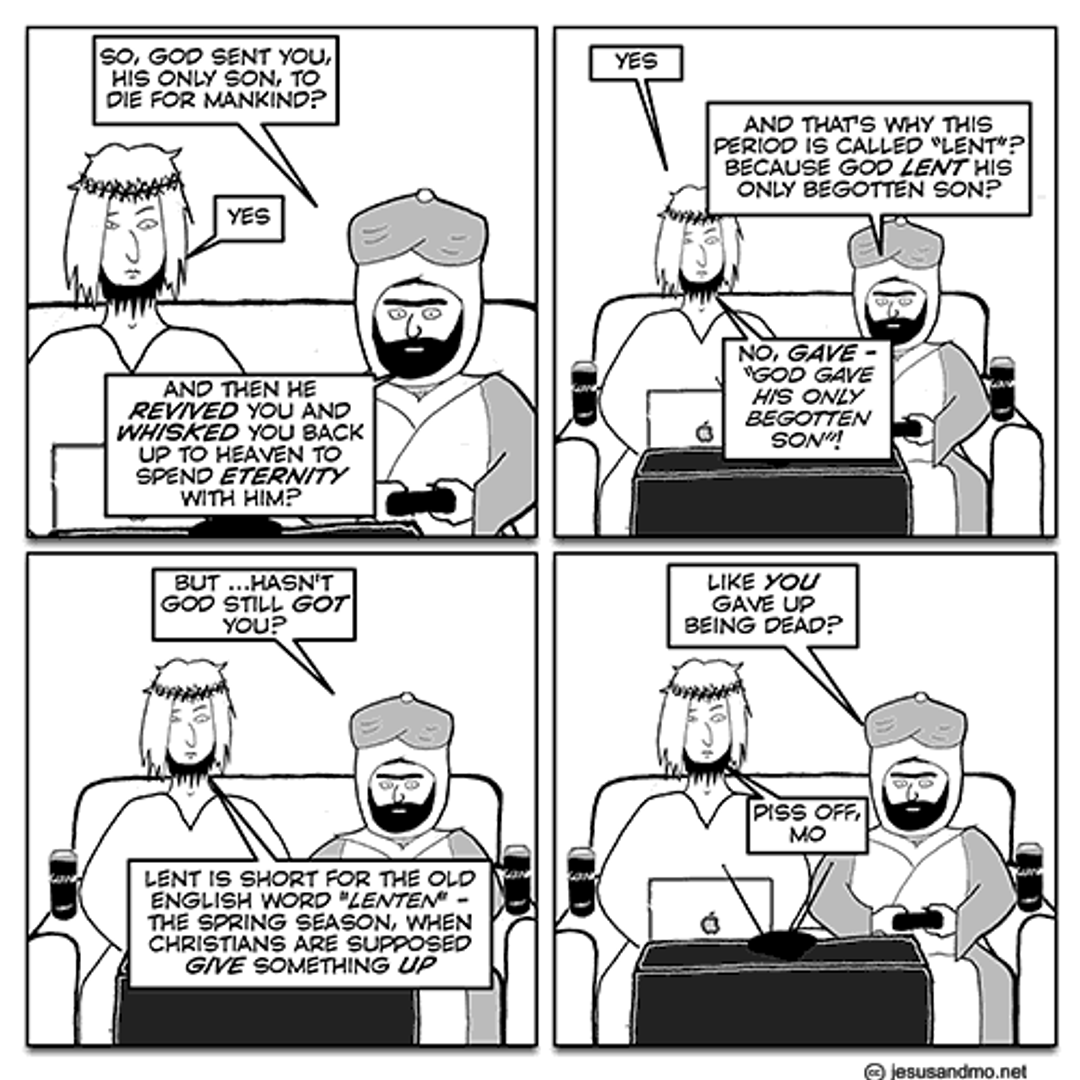
Jesus ‘n’ Mo ‘n’ Lent
The Jesus and Mo artist has recycled an old strip for Lent, which goes from Feb. 18 through April 2. The caption is this:
Friday Flashback – because we’re in the middle of Lent. You didn’t forget, did you? Heathens!
Mo shows here that he has at least a tad of a sense of humor.
The Sun’s Long-Lived Active Regions Are Massive Flare Factories—But We Don’t Know Why
Space weather is a fascinating subject, but one we still have a lot to learn about. One of the main components of it is the active regions (ARs) of the Sun. These huge concentrations of magnetic fields show up throughout the Sun’s photosphere and are the primary source of solar flares and coronal mass ejections (CMEs). They can be simple pairings of magnetic flux or huge, magnetically complex tangles that spend weeks creating massive solar storms before dissipating. But tracking the longest lived of these ARs has been a headache for solar physicists, and a recent paper by Emily Mason and Kara Kniezewski, published in The Astrophysical Journal, both dives into this tracking problem and uncovers some interesting features of the Sun’s most persistent ARs.
Scientists solve 12,800-year-old climate mystery hidden in Greenland ice
A negative attitude towards ageing is making you age faster
Astronomers discover nearby galaxy was shattered by cosmic crash
Scientists turn CO2 into fuel using breakthrough single-atom catalyst
Vaccines Work. Here’s Why We Care About Your Unvaccinated Child.
While normal people don't want any child to suffer or die because their parents were tricked by disinformation, the leaders of the anti-vaccine movement, who profit by lying about vaccines, don't care at all.
The post Vaccines Work. Here’s Why We Care About Your Unvaccinated Child. first appeared on Science-Based Medicine.Canada Allocates $200 Million Towards the Creation of Nation's First Spaceport
Minister of National Defence David McGuinty announced on Monday, March 16th, that the Canadian government is committing $200 million to develop Canada's first commercial spaceport in Nova Scotia, which will be run by Maritime Launch Services.
The Crab Pulsar's Puzzling Emissions Finally Explained.
Pulsars are rapidly rotating neutron stars. The Crab Pulsar, an often studied supernova remnant, is known for its unusual radio emission patterns. New researchs says it's because of a "tug-of-war" between magnetism and gravity. Gravity acts as a focusing lens and plasma in the magnetosphere acts as a defocusing lens.
Pages
