
You are here
News Feeds
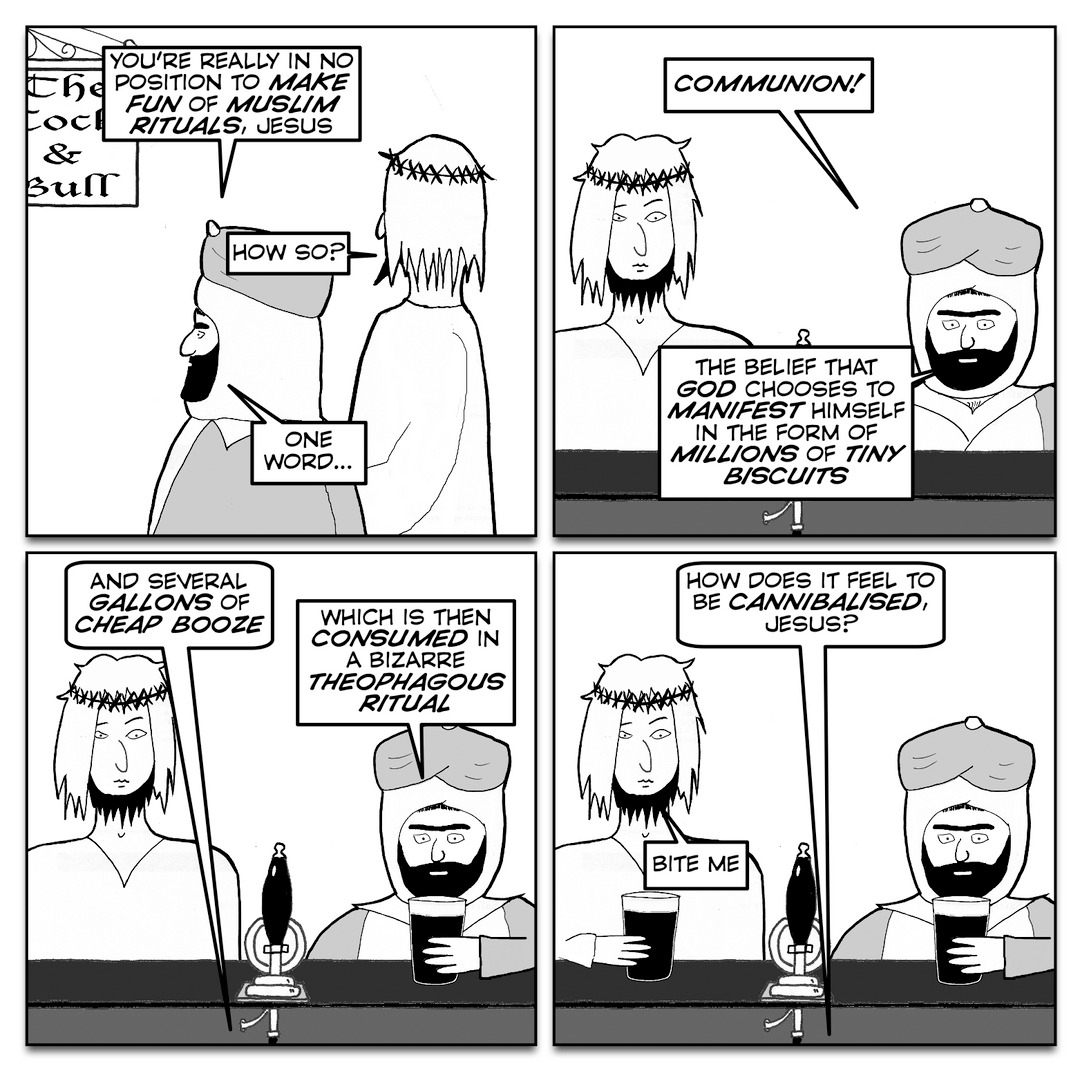
Jesus ‘n’ Mo ‘n’ crackers
This week’s Jesus and Mo strip, called “bite2”, is new but came out a bit late on Wednesday. In response to last week’s criticism of Islam, Mo now gets the chance to make fun of Christian ritual. He does a good job, but Jesus gets the last word.
Desmond Morris (1928–2026): A Keen Observer of the Human Condition
Zoologist by career, TV celebrity in the 1960s, renowned surrealist painter, and bestselling author of more than 70 books, Desmond Morris left a legacy that enlightened our species, answered taboo questions, and made audiences around the world look at behavior with renewed eyes. This is a tribute to one of the greatest observers of human behavior.
He never shied away from controversy. His first popular book, published in 1967, proclaimed on its cover what at the time was seen as offensive: that we humans are “naked apes.” The logic was compelling: if one were to place close to 400 primate species side by side, a quick visual inspection would reveal that the most notorious difference is the general lack of body hair in humans. Not intelligence, not language, not technology. That was the beginning of his effort to spoon-feed society a lesson in evolutionary humility: there is nothing insulting in seeing humans as animals; every species is extraordinary in its own way.
Going back to that book, in his 1979 autobiography Animal Days, Morris recounts the 30 days he took to write the whole manuscript for The Naked Ape on a typewriter, without editing—an astonishing result by any measure. The book spread fast not only because of its provocativeness, but because the world got to experience what descriptive, entertaining, and compelling writing can do when science merges with audience-centered prose. With over 20 million copies sold, it still stands among the 100 bestselling books in history.
Desmond’s curiosity was unstoppable, and it can be traced back to his unusual rise in academic science through the study of animal behavior. His Ph.D. began with small fish, sticklebacks. While his mentor Niko Tinbergen—the man who showed him there was a path for studying animals without putting them in cages through ethology—was adamant about the importance of specializing in a single species, Desmond rebelled against that idea. That was his character. He then expanded, in his postdoctoral studies, to birds, particularly the small finch. By this time his basement at the university had become overcrowded with multiple species, and there was even an aviary on the department’s roof. No fewer than 84 species passed through his lab during this period at Oxford. He was able to dedicate three full years to the ten-spined stickleback, while exploring variation in other species, fulfilling his tendency to be a “spreader”—to broaden his interests too much.
Out of academia, Morris became curator of the largest collection of mammals at the renowned London Zoo, sharpening his observations across more than 300 species. His insatiable curiosity pushed him to want to know everything there was to know about every mammal. He later focused on our closest relatives, non-human primates, such as Congo—the chimpanzee he taught to paint and whose works ended up in the hands of world-class painters like Picasso and Miró. Again, non-human primates were only a pitstop before the next stage, an obvious one to him: humans.
Once The Naked Ape skyrocketed, Morris moved to Malta, where he enjoyed the pleasure of spending his earnings and living a comfortable life. There he realized something that we may better understand from the flip side: “The city is not a concrete jungle, it is a human zoo.” Under that premise, he published what could be seen as a follow-up to The Naked Ape, called Human Zoo (1969), where he revisits controversial topics of status, sex, and power. From this work, his commandments of dominance are priceless. He lists the behaviors that, in primate species, are associated with gaining and defending power and status, like “make changes even if no change is needed to demonstrate that you are in control” or “a leader should display his position in their demeanour.” All his work cultivated a unique view of the human animal through the lens of ethology, or through Desmond’s eyes.
Then, motivated by his book editor, Morris began the odyssey that he never finished. It started with a simple premise: a full description of the repertoire of human behavior. After a few months of work, his editor asked about his progress, and he said he was covering the eyebrows. To the editor’s surprise, he had started not from the feet but from the top of the head. That was a sign that his dedication to cataloging gestures was going to take him a lifetime, much like the Oxford English Dictionary (OED).
Not coincidentally, Morris moved to North Oxford, to the house of James Murray, one of the main lexicographic contributors to the OED, as if foreshadowing his own intentions. His book originally titled Manwatching (1977), later adapted to the zeitgeist of our times as Peoplewatching (2003), is still, to this day, the most exhaustive and profound description of human behavior. I believe it offers the highest rate of insight per sentence among all the books I’ve read, and I have called it the bible of human behavior. Ten years later Morris produced another version of that project, this time focused on areas of the body, covering each one through biology, anatomy, culture, and behavior, called Bodywatching (1985). For the serious human observer, these two are indispensable guides.
But Morris knew that the journey was longer than a book. The human repertoire of behaviors cannot be compressed into a trade book. He kept collecting behaviors, labeling them one by one. He had to coin names for many of them, because code-to-elbow or nose-to-forehead behaviors are not commonly described in ordinary language. His approach aimed to solve the natural ambiguity of behavior, so he used descriptive labels to avoid subjective interpretations. His encyclopedia of human actions, titled The Human Ethogram, reached at least two thousand entries by the time he decided to let it go. Now those archives sit at the University of Porto, at the Museu de História Natural e da Ciência, where at some point they may be compiled into one of those posthumous manuscripts worthy of Desmond’s legacy.
Morris’s success transcended writing, probably inspired by the admiration he held for Julian Huxley, a trailblazing biologist who broke scientific etiquette by appearing in mass media. Desmond became a celebrity-like figure with his weekly TV show Zootime. Each week he introduced audiences to different species from the London Zoo, where he worked. The anecdotes are hilarious, and his descriptions of behavior glued audiences to topics they otherwise might have ignored. He developed a charismatic presence that evolved further in his documentaries.
Over his life Morris ended up writing three autobiographies, each time adding new elements, culminating in his more than 600-page 2006 memoir, Watching. This book is as funny as a comedy, and it has the depth and texture of stories that let you enjoy and learn in equal parts. In it, Desmond shares an observational palate so rich that he successfully predicts winners of sumo fights, accidentally receives a papal blessing from Paul VI, and is mistaken for British intelligence in Moscow.
Since 2017, I have had the great good fortune to be in regular contact with Desmond Morris. We exchanged ideas, discussed a few gesture interpretations, like the elbow clapping, and he revealed that his favorite animal was the chequered elephant shrew. He kindly wrote a letter of recommendation for my Ph.D., gave me a few signed books, and invited me to dinner with his family in Ireland. I conducted one of the last interviews with him.
Desmond Morris with the author, Alan Crawley.Over these years I asked Morris many questions. Among them was: “If you have to give a single recommendation to those interested in studying nonverbal behavior, what would it be?” Here is Desmond Morris’s insightful response (personal communication, 03/03/2021):
With body language studies, it is my impression that there is often too much abstract theorizing and semantic debate, when we should be getting out in the street conducting field studies. The question I would ask any student of human behavior is “How many hours of field observation have you done?”, not “How many theoretical papers have you written?” How many riots, bar-fights, pop concerts, boxing matches, art auctions, festivals, law courts, beach parties, military parades, religious gatherings and sporting events, have you attended as an objective, body language observer?Desmond had in mind Tinbergen’s warning about his tendency to spread too thin across multiple problems and numerous species, a signature of his identity. That tension lived in the two sides of his personality: scientific researcher and popularizer. Those identities wrestled within him, and both appear relentlessly in his work and demeanor. For example, in Oxford Morris bought the neighboring house to accommodate his collection of more than 20,000 books. Intrigued by how many of them he had actually read, I asked. His answer was revealing:
I can’t remember the last time I read a book cover to cover.That line reveals the tradeoff between scope and depth. Morris consumed texts across domains, ages, and styles, allowing him to create unique compilations of facts organized under a single ethological framework, something that could only have been achieved by an unsatisfied curious mind that pursued one question and then moved on to the next. Such an approach may increase the likelihood of stating inaccurate claims, and some people use Desmond’s mistakes as a convenient excuse to discard the rest of his ideas. That is a dishonest and unfair approach. He was a prolific well of novel ideas: where others saw laughter, he saw an evolved mechanism of tension; where Freud saw sexual fixation, Morris described behavioral relics that increase in frequency under discomfort.
Awards and prizes were not his motivation. He was never interested in being knighted as a Sir. Someone of his accomplishments would have been a strong candidate for such recognition. I once asked him about this, to which he replied in his unique humorous manner:
I have made enough rude comments about the authorities and about politicians to ensure that my name is safe from that nonsense. And The Naked Ape won’t have helped.Morris was well aware of the consequences brought on by the depiction he made of the human animal. Those depictions may have reached their widest audience through his TV documentaries, like The Human Animal, a fantastic visual portrayal of human behavior across more than 40 cultures.
Desmond enjoyed his competing interests—writing and painting—which occupied his mind deeply throughout the day. In his words:
There are two Desmond Morrises, and they are quite different people. I can easily pass from one to the other, but I cannot be both at the same time. When I'm Desmond Morris the painter, I am quite different.... There is rarely any clash between the two aspects. The one helps the other. I obey the two sides of my brain alternately.Morris’s legacy is gigantic. Beyond more than 12 books on human behavior, he produced books on the behavior of dogs, cats, horses, primates, bison, leopards, and owls. Yet his impact on surrealism was far more than a hobby. Not only were books like The Lives of Surrealists (2018) influential, but, more importantly, in 1950 his paintings were exhibited in galleries alongside Joan Miró. He was an accomplished surrealist painter and filmmaker. If you have read Dawkins’ most famous book, The Selfish Gene, you may have encountered one of his paintings, since Richard himself chose one for the cover.
Until his last days he kept painting and writing. In perspective, he was an outlier who reached the highest level in two incredibly different professions through sheer excellence. And that excellence was cultivated over time, until the end.
For the past five years, he shared in his emails that he woke up with the desire to write and paint—a man in his late 90s who continued relentlessly to enjoy his daily work. Someone who, at the age of 95, published three books in a single year. This year he was also doing two gallery exhibitions of his paintings. That was Desmond: an unstoppable force of passion and curiosity.
Thanks, Desmond. We will continue watching for you.
See the Moon Occult Regulus for The Americas Saturday Night
Much of visual astronomy requires nothing more than clear skies, keen eyes, and patience. If you’re out skywatching Saturday evening and live in North or South America, watch for the waxing gibbous Moon pairing with Regulus at dusk. For a privileged region, the Moon will actually blot out or occult the star, in one of the best-placed lunar occultations of a bright star for 2026.
Astronomers may have found a strange new kind of cosmic explosion
Savannah: Day 6
It was a lazy day today, with one visit to an architectural/history site and then one big and delicious meal. After we had a leisurely breakfast and did our ablutions, it was nearly 11 a.m. We then walked the ten blocks to the Owens-Thomas House and Slave Quarters:
The Owens–Thomas House & Slave Quarters (originally known as the Richardson House) is a historic home in Savannah, Georgia, that is operated as a historic house museum by Telfair Museums. It is located at 124 Abercorn Street, on the northeast corner of Oglethorpe Square. The Owens–Thomas House was designated a National Historic Landmark in 1976, as one of the nation’s finest examples of English Regency architecture.
Renovations in the 1990s uncovered and restored one of the oldest and best preserved urban slave quarters in the American South.
. . . The house is notable for its early cast iron side veranda with elaborate acanthus scroll supports on which the Marquis de Lafayette addressed the citizens of Savannah on his visit in 1825.
The house was built between 1816 and 1819, designed by the architect William Jay of Bath and financed and occupied by Richard Richardson. It was then purchased by attorney and politician George Welshman Owens, who was briefly mayor of Savannah and later a U.S. Representative.
The Owens family lived in the house for a while, but after some decades turned it into a boarding house, which is when Lafayette stayed there on his final visit to America on the 50th anniversary of the American Revolution—in which Lafayette played a huge role.
In 1951 the family turned the house over to the Telfair Academy of Arts and Sciences , which still owns it (I visited the other two parts of the Museum on my first day here).
The sign below gives pretty much the same information above.

The front of the house (I forgot to photograph the famous balcony). When Lafayette, an abolitionist, visited Savannah in 1825, the town kept all the slaves inside, along with the free blacks, so they wouldn’t be incited by Lafayette’s antislavery sentiments.

The back garden of the house, designed to be completely symmetrical. In the rear are the slave quarters. This is only part of them: the small house held 12 people, and there were a bit more than 20 enslaved people working for the white residents.

This sign was in the slave quarters, explaining why the guides and many of the signs used the terms “enslaved people” instead of “slaves.”

Inside the quarters, which slept at least twelve people, though many of the enslaved, like the cook and those who took care of the chlldren, slept inside the big house.

The dining room. Food was cooked in the basement, and since there was no dumbwaiter it was carried on trays up two floors from the basement and put in the butler’s pantry before being served.

The butler’s pantry was a small room, with four empty bottles of wine sitting on the sideboard. As the tour moved on, I picked up one of the bottles and saw what’s below: a bottle of Barton and Guestier bordeaux—from 1870! I’d never held a wine bottle that old before. And this chateau is still going strong; it was founded in 1725.

The structural material of the house was tabby, an equal mixture of sand, burnt oyster shells, water, and ash. It was an early form of concrete, and was quite durable. As you see, the tabby was covered with wood paneling.

This room was presumed to be the library/study, though now they’re unsure what all the rooms were used for.

This is presumed to be the oldest son’s bedroom.

And a mirror, at the bottom of which you can see a selfie of Professor Ceiling Cat (Emeritus):

The (presumed) master bedroom, now a word that’s out of favor for obvious reasons (I can’t remember what it’s supposed to be called now).

After the tour we walked home and then got in the car to drive to a restaurant I’d scoped out as a likely prospect: great food, not overly expensive and, most important, Southern. Yes, we went to Erica Davis Lowcountry. It turned out to be all I hoped for, though if you drove by this place you wouldn’t think to go in. But you’d be making a mistake if you didn’t.

We split two appetizers. First, oysters Rockefeller made with local oysters. Wikipedia describes the dish this way:
Oysters Rockefeller is a dish consisting of oysters on the half-shell that have been topped with a rich sauce of butter, parsley and other green herbs, bread crumbs, and then baked or broiled.
There were also collard greens, cream. and Parmesan cheese. It was scrumptious—the first time I’ve had this dish. With all that garnish you could still taste the oysters, and I love oysters. You’d think the dish would be too busy with all the ingredients, but the flavors mingled perfectly.

Another Southern classic: fried green tomatoes, these with feta cheese and balsamic vinegar reduction.

The menu was so full of good stuff (see the link above) that I asked the waiter what she recommended. Without question she mentioned the shrimp, which are local, fresh, and delicious. So I got a half pound of boiled shrimp. They came with clarified butter, shrimp sauce, and two sides (I chose cheese grits and deep-fried okra). And oy, were those shrimp good! I ate the shells, of course, as all good shrimp lovers do.

Tim had the Wassaw redfish, described as “pan-seared redfish filet, garlic beurre blanc, heirloom tomato, stone ground grits, fresh green beans.” He pronounced it excellent.

Betsy had two crab cakes along with green beans and cole slaw. As expected, the cakes were almost all lump crabmeat, with just a small amount of filling to hold them together. With a little bit of the sauce on the crab, it was a Platonic version of this dish.

And my Southern dessert: the third helping of banana pudding I’ve had on this trip—this time served in a Mason jar. This was the fanciest version of all I’ve had. As you can see, it’s topped with whipped cream dusted with vanilla wafer crumbs, with a whole wafer on the side. (Banana pudding sans vanilla wafers is unthinkable.) Then there’s a layer of banana pudding, then a layer of cake, and then a bottom layer of pudding with chunks of banana. This was the best version I had on this trip, and probably the best version I’d ever had. (I’ve eaten it many times, often with BBQ or a meat-and-three plate in the South.)
The meal was terrific, not very expensive, and prepared with great care. I’d recommend this place very highly to anyone who visits Savannah.

Symptoms of early dementia reversed by bespoke treatment plans
QBox theory may offer glimpse of reality deeper than quantum realm
Is stem cell therapy about to transform medicine and reverse ageing?
The MAHA Amnesia Project
The same disinformation agents who are trying to erase the history of the pandemic, are also trying to erase the history of MAHA.
The post The MAHA Amnesia Project first appeared on Science-Based Medicine.Interstellar Comet 3I/ATLAS Left a Trail of Methane in its Wake
A new analysis of data obtained by JWST on 3I/ATLAS as it was on its way out of the Solar System (in December 2025) showed that its interior is rich in methane ice.
New Research Reveals That Interstellar Comet 3I/ATLAS Formed in a System Far Colder Than Our Own
The interplanetary comet 3I/ATLAS is remarkably rich in a specific type of water that contains deuterium, meaning it came from somewhere colder and with lower levels of radiation than our early Solar System.
This Bathtub Ring of Minerals is More Evidence for an Ancient Warm, Wet Mars
NASA's MSL Curiosity rover found a bathtub ring-like deposit of zinc, manganese, and iron in Gale Crater. These metals precipitate out of water in the right conditions, and there's not really any other way they could've become concentrated here. Adding to the excitement, these deposits also form in lakes on Earth, where the concentrated metals are food for some types of bacteria.
Largest-ever octopus was great white shark of invertebrate predators
Do you need to worry about Mythos, Anthropic's computer-hacking AI?
The Most Energetic Neutrino Ever Detected Could Be Primordial
Neutrinos are very difficult to detect. And when they are detected, pinpointing their sources is likewise difficult. New research shows that the most energetic neutrino ever detected must have had an extraordinarly energetic source. It could even be primordial.
Catching a cold can delay cancer from spreading to the lungs
The Strange Case of Bob Lazar
In 1989, Bob Lazar told Las Vegas reporter George Knapp that he had worked at a secret facility called S4 near Area 51, where his job was to help reverse-engineer the propulsion system of a craft “not made by human hands.”
More than three decades later, despite other whistleblowers alleging the existence of such programs, Lazar remains a rare figure in claiming direct technical work on a purportedly non-human vehicle. And he is now back in the spotlight because a new documentary, S4: The Bob Lazar Story, directed by Luigi Vendittelli, was released on Amazon Prime in early April 2026, and Lazar then did a burst of media coverage, including Joe Rogan, Area52, and Jessie Michels.
He has claimed to have earned two master’s degrees, one in physics from MIT and the other in engineering from Caltech. Skeptics reported finding no record of him at either institution.Lazar is a contested figure. He has claimed to have earned two master’s degrees, one in physics from MIT and the other in engineering from Caltech. Skeptics, including ufologist Stanton Friedman, reported finding no record of him at either institution and have pointed to the absence of identifiable professors or classmates who could corroborate his attendance. Friedman also cited evidence that Lazar attended Pierce Junior College in Los Angeles, which he argued was difficult to reconcile with the timeline Lazar later described. Lazar has maintained that records connected to his work were altered or removed. He also pleaded guilty in 1990 to a felony pandering charge in Nevada. Taken together, these elements have remained central to skeptical assessments of his credibility.
But beyond these biographical facts lies a deeper disagreement about how his case should be evaluated at all. Part of the friction in the Lazar debate is about what kinds of evidence people are willing—or able—to perceive. When you listen to Lazar at length, you start processing how his claims are generated. Over time, it produces a strong impression that the account is being recalled rather than constructed. Notably, individuals who have spent extended time with Lazar without prior exposure to his story have described a similar shift: from initial skepticism to the sense that they were dealing with a person recounting, rather than constructing, an experience. For some observers, that distinction becomes difficult to ignore.
Many skeptics, however, operate with a different evidentiary filter. When claims are extraordinary, they tend to discount behavioral authenticity signals almost entirely, treating them as unreliable or irrelevant. Testimony, in this view, is flattened: people lie and misremember, and beyond that there is little to be extracted from the manner of delivery. This has the advantage of protecting against being misled by charismatic or deceptive individuals. But it also comes at a cost. It removes from consideration a set of cues that, while imperfect, are often central to how humans actually evaluate one another in real-world contexts.
So we are left with a perceptual mismatch. Where one person sees constraint, specificity, and resistance to fabrication, another sees only an unverified claim. One may register the difference between a narrative that is expanding versus bounded, while another treats both as functionally equivalent. On top of this, many skeptics place heavy weight on abstract priors—chief among them the assumption that non-human technology is so unlikely that no amount of testimonial evidence can meaningfully shift the balance. Once that prior is fixed, the rest of the evaluation becomes largely procedural.
This produces a kind of epistemic stalemate with asymmetrical risks. If behavioral signals are granted no weight, then no amount of constraint, consistency, or non-performative delivery can ever move the needle. Testimony collapses into a binary of verified or dismissed, and cases like Lazar’s are effectively decided in advance by prior assumptions. But if those signals are taken seriously, even provisionally, then the burden shifts: one can no longer dismiss the account wholesale without offering a comparably structured alternative explanation. The alternative explanations largely fall into two categories: 1) Bob Lazar fabricated the story, or 2) Bob Lazar is sincerely recounting a real experience that he fundamentally misinterpreted.
Before turning to those explanations, it is worth acknowledging that Lazar’s disputed credentials and legal history are real and relevant, and any serious assessment has to take them into account. They establish that he is not an unimpeachable witness and that elements of his biography invite skepticism. Whether they are sufficient, on their own, to resolve the case is far less obvious.
Bob Lazar is a FabulistLazar’s central claim has not been proved, but several elements once dismissed as fantasy have since entered the documentary record. After his account told to George Knapp, Area 51 was eventually acknowledged by the CIA, and federal litigation in the 1990s showed that the government was willing to invoke state-secrets doctrine and repeated presidential exemptions to shield information about the Groom Lake site. That does not prove Lazar worked on non-human craft, but it does mean one major plank of the old dismissive posture—that he had built an outlandish story around an imaginary place—has aged badly.
The CIA’s own history describes daily air shuttles moving personnel and cargo to the facilityThe same is true of the surrounding logistics and of Lazar himself. Beyond a secret base in the desert, his story concerned a tightly compartmented installation serviced through unusual access patterns, including shuttle flights out of Las Vegas. The CIA’s own history describes daily air shuttles moving personnel and cargo to the facility, and reporting from Las Vegas has since made the JANET system (or Janet Airlines—a highly classified, top-secret airline operated for the United States Air Force) and its secure terminal common knowledge. Again, this proves far less than believers want. But it also proves more than skeptics used to allow. A fabulist could have been lucky once. He is harder to dismiss as a mere fabulist when elements of the practical architecture around his story keeps turning out to be real.
It is also worth recalling the context in which these claims were first made. In 1989, even within UFO circles, the idea of intact craft in government possession—let alone reverse-engineering programs—sat at the fringe of an already fringe field. The involvement of the U.S. Navy in such matters was not part of the discourse at all. Whatever one ultimately makes of Lazar’s account, it did not emerge as a straightforward amplification of existing narratives.
Then there is Lazar himself. Whatever one makes of his grander claims, it is no longer serious to imply that he was simply invented out of whole cloth as a nobody pretending to have moved in scientific circles. A 1982 Los Alamos Monitor article identified him as a physicist at the Los Alamos Meson Physics Facility, years before the UFO story made him notorious. Even the skeptical archival work that has tried hardest to reduce that credential concedes the key point: Lazar was in the Los Alamos world, and the facility in question was a major user laboratory hosting large numbers of outside researchers and contractors. That does not settle what his precise status was, but it does narrow the space for the old picture of Lazar as a basement fantasist who conjured a scientific persona after the fact.
Taken together, these later confirmations vindicate enough of the external scaffolding of his story to make the pure-fabulist thesis look increasingly strained. Even the once-mocked reference to element 115 no longer belongs to the category of obvious fantasy, though its later recognition by IUPAC does not validate Lazar’s specific claims about a stable isotope or gravity propulsion. But the record increasingly undermines the idea that he spun his tale out of pure nonsense.
The most common objection to Lazar’s credibility concerns his lack of verifiable academic records, particularly his claim of having attended MIT. This is often treated as dispositive. But it only is if one assumes a normal career trajectory. Lazar has consistently maintained—publicly in broad terms, and in more detail in private conversations—that his presence in that environment was tied to recruitment into classified work. If that is even partially true, the absence of a standard paper trail is a predictable outcome. That explanation may be challenged, but it is not incoherent, and it is not obviously less plausible than the idea that an individual capable of navigating Los Alamos environments simply fabricated an MIT background without anticipating the most obvious line of scrutiny.
That is why the fabulist position now looks less like skepticism than inertia. That model asks us to believe that Lazar wrapped an elaborate falsehood around a secret aerospace world he happened, by chance or intuition, to sketch in several increasingly accurate ways before much of that world entered the public record. That is possible, but it is no longer the modest position. Too much of the story’s external scaffolding has since been independently corroborated to go on speaking as if we are dealing with a man who simply spun a science-fiction yarn out of thin air.
Bob Lazar is Sincere but MistakenLazar may not be lying, this argument goes, but that does not mean he is reporting reality accurately. He may be recounting a real experience, interpreted incorrectly.
At first glance, this sounds like a reasonable position. It avoids the embarrassment of outright credulity while refusing the cheap certainty that he is simply a fraud. It lets one acknowledge the obvious fact that Lazar does not present like a conventional fabricator without having to follow that concession where it may lead.
“He believes what he is saying” has no explanatory power.The trouble is that this middle position is often treated as though it were self-supporting. It is not. “He believes what he is saying” has no explanatory power. It tells us something about Lazar, but almost nothing about the world. To get from there to a real account of events, one has to specify how a sincere man ended up with this particular story: a decades-long account of a highly unusual engineering environment, populated by sharply bounded details that do not behave like decorative embellishments.
A more concrete version of the “sincere but mistaken” hypothesis is sometimes proposed: that Lazar did have some level of access to classified environments, but in a limited or peripheral role—variously described as a technician, contractor, or even something as mundane as scanning badges—after which he constructed a far more elaborate narrative around fragmentary exposure. In this version, the expansion is not assumed to be deceptive, but the result of inference that gradually hardened into belief. This is, in many ways, the strongest non-fabulist alternative. It preserves sincerity, explains his familiarity with certain logistical details, and avoids the need to posit a decades-long fabrication.
But this refinement simply relocates the core difficulty. It still has to explain how limited, peripheral access could generate a highly specific, mechanically structured account of a system he would not have meaningfully interacted with. It must also explain why that account exhibits the same constraint, stability, and resistance to embellishment as a bounded recollection, rather than the looser, more adaptive structure one would expect from extrapolation. In other words, it replaces one explanatory burden with another, without clearly reducing the overall cost.
He says he did not believe in flying saucers and thought those who did were nuts.One striking thing is that Lazar describes initially drawing the ordinary conclusion. When he first saw the craft, he says the American flag on it made him think it belongs to the US, a top-secret breakthrough that would explain the UFO reports he had previously dismissed. He says he did not believe in flying saucers and thought those who did were nuts. Only later did he conclude that it was not human-made. In his account, the non-human inference was what he was pulled into by the structure of the work itself.
That is already a problem for the standard middle position. It means the “misinterpretation” in question cannot be a simple matter of a UFO-minded witness projecting his prior beliefs onto an ambiguous event. Lazar’s own account begins with the conservative interpretation and moves away from it only when the setting itself stops making sense under that frame. The skeptic who grants that Lazar is sincere now has to say more than “people can be mistaken.” Of course they can. The question is: mistaken about what, exactly?
That question becomes sharper once one notices the kind of details around which his account is built. The memorable parts are not the ones a hoaxer would obviously choose. Instead of dwelling on awe, he repeatedly says the dominant feeling when coming into contact with the craft was ominous, even creepy. The emotional tone is constraining.
One need not treat that as decisive.The same is true of the physical details. Lazar describes the inside of the craft not in grandiose terms but in awkward, almost inconvenient ones: no seams, no stylized features, the same sheen and radius of curvature everywhere, light behaving strangely inside, halogen lamps illuminating where they were aimed but failing to brighten the surrounding interior the way one would expect. Luigi Vendittelli, director of the S4 documentary that recreated the facility in a VR environment, says that when they built the set, they ran into exactly this problem: the interior remained unexpectedly dark. He presents this as one of the moments that made him feel Lazar had not simply invented a cool image but was describing a physicality that does not lend itself easily to intuitive fabrication. One need not treat that as decisive. But it is exactly the sort of thing that makes the middle position harder. The details are bounded in ways that feel discovered rather than chosen.
That distinction is central. A constructed story tends to optimize for effect, and answers too many questions. Lazar’s account contains stubborn little irregularities. He says the craft turned into sky when he walked beneath it because the light bent around it, and that the weight was simply gone rather than transferred to the ground. He describes people working around a purportedly non-human craft in a surprisingly nonchalant, dusty hangar rather than in the kind of sterilized environment one might imagine from science fiction. These details raise the cost of the fallback explanation that he is sincere and simply mistaken.
He also describes intimidation tactics after going public.We are also not in the presence of a private mythology floating free of the world. Lazar told Gene Huff first, then John Lear, and brought them out to see a Wednesday-night test flight because he had the schedule. He also describes intimidation tactics after going public: locked car doors and trunks found open, houses entered, George Knapp himself being followed. One can reject some or all of that. But once again, the middle position cannot simply wave it away with the generic proposition that sincere people can misread events. It has to say what kind of reality generates this pattern.
“He believes it” allows a skeptic to concede the very thing that gives the case its force while refusing to pay the price of that concession. But once sincerity is granted, the path to error is no longer cheap. It has to explain why Lazar’s account exhibits the structure of a constrained recollection of a specific environment, rather than that of an interpretation layered over an ambiguous experience.
In short, Lazar’s central claim—the custody and reverse-engineering of non-human craft—remains unproven, but the standard counterclaims do not carry the weight often assigned to them. Treating Lazar as a fabulist requires a level of sustained fabrication that sits uneasily with the structure of his account and its partial alignment with a once-hidden environment. Treating him as sincere but mistaken requires a chain of error that struggles to generate the specific, constrained features of the story. Neither path collapses under scrutiny, but neither settles the matter.
What remains is a less comfortable position: the case resists easy resolution, and the confidence with which it is often dismissed exceeds the explanatory work that has been done.
Huge study reveals how Epstein-Barr virus may cause multiple sclerosis
The COVID Amnesia Project III: The Plot to Erase Who Ordered Lockdowns in 2020
Dr. Jay Bhattacharya is fully of contempt and vitriol for doctors who worked in hospitals, but he literally “loves” lockdowners.
The post The COVID Amnesia Project III: The Plot to Erase Who Ordered Lockdowns in 2020 first appeared on Science-Based Medicine.The Mechanics of Alien Waves
One of the most dramatic and memorable scenes from Interstellar comes from Miller’s planet - and if you don’t want a spoiler for an 11 year old movie, feel free to skip to the next paragraph. When the crew arrives on this potential new home for humanity, they are faced with a literal 1.2 km high wall of water bearing down on them quickly. It’s a great representation of how waves on other planets can act differently than on Earth. Admittedly, according to Kip Thorne, the scientific advisor for that movie, those waves are actually caused by the planet’s proximity to a local black hole rather than the wind that forms our waves here.
Pages
